
What is Chemical Dosing System? How Does It Work?
In modern industry and water treatment processes, the chemical dosing system is for ensuring stability in production, process safety, and compliance with water quality. Through precise control of the amount of chemical agents supplied into the system, it provides repetitive reactions and outstanding operating efficiency. In municipal wastewater treatment plants, industrial circulating water systems, and in the food processing industry, dosing systems are indispensable equipment.
In this article, we will provide a full description of the structure, principle of operation, application fields, and selection tips of chemical dosing system, and elaborate further why increasingly more companies are choosing the peristaltic pump as the core of their dosing systems.
Part 1. What is a Chemical Dosing System?
A chemical dosing system is a computer-controlled unit deployed for precise dosing of chemical products. It injects a defined amount of acid, alkali, chlorine, coagulant, or other chemicals into process lines or storage tanks to realize objectives such as pH correction, disinfection, scale stripping, or reaction control.
Manual dosing methods of the past not only result in wastage but may also lead to chemical waste as well as safety hazards. As compared to an automated chemical dosing system, which can:
- Ensure a constant chemical concentration
- Ensure stable continuous chemical reactions
- Eliminate risks associated with manual operation
- Improve overall operating efficiency and economy

Part 2. Main Components of a Chemical Dosing System
A complete chemical dosing system typically consists of numerous significant parts that communicate to deliver accurate, consistent, and seamless dosing performance:
1. Chemical Tank
The chemical storage tank holds the chemical solution to be dosed. It is usually made of polyethylene (PE) or polypropylene (PP), both of which have good resistance to corrosion and long life. The tank may be fitted with devices such as a level indicator, vent filter, and mixer unit in order to maintain uniform chemical concentration.
2. Dosing Pump
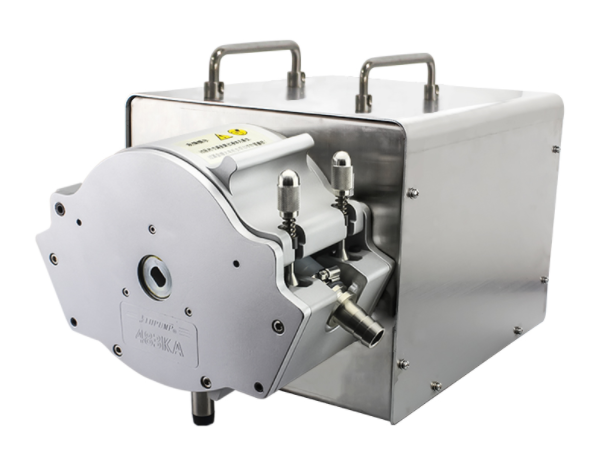
The dosing pump forms the nucleus of the entire system, delivering a set quantity of chemical liquid to the process. Common types include peristaltic pumps, diaphragm metering pumps, and plunger pumps.
Among these, the peristaltic pump stands out for its precision, simplicity of maintenance, dainty handling of fluid, and absence of contamination, and therefore is in high demand in many dosing applications.
3. Piping System
The piping system connects the chemical tank, pump, and dosing points. It is typically constructed of corrosion-resistant materials such as PVC, PTFE, or silicone tubing to provide chemical compatibility and robustness even in harsh applications.
4. Control Unit
The control unit is responsible for controlling the entire dosing process. It is equipped with sensors, flow meters, and PLC controllers to facilitate automatic monitoring, flow control, and safety control.
Sophisticated systems can even support remote monitoring, alarm capabilities, and data recording to enable precise and smart handling of chemical dosing.

Part 3. Working Principle of a Chemical Dosing System
A chemical dosing system operates through an automatic closed-loop process of “Detection → Calculation → Dosing → Feedback”, which enables precise and uniform chemical control throughout the treatment process.
The general process flow is as follows:
Detection of Process Parameters
Sensors monitor continuously key water quality parameters such as pH, ORP (oxidation-reduction potential), or residual chlorine concentration. These instant readings are the foundation for adjustments to chemical dosing.
Calculation of Required Chemical Volume
The measured values are compared by the control to setpoint targets. When deviations are observed, the system determines the precise amount of chemical to restore balance so that the process remains in optimal parameters.
Chemical Injection by Dosing Pump
The dosing pump is activated to precisely inject the calculated amount of chemical solution into the reaction tank or process stream. Smooth, pulsation-free dispensing by peristaltic pumps guarantees accuracy and guards against overdosing or underdosing.
Feedback and Real-Time Adjustment
After dosing, the system still monitors the resulting change in water quality. When parameters still remain out of the desired range, the controller automatically adjusts the dosing rate to balance for stability.
Through the process being automated and self-correcting, the chemical dosing system achieves high precision, minimizes wastage of chemicals, and guarantees reliability, safety, and efficiency of the process as a whole.

Part 4. Main Application Fields of Chemical Dosing Systems
chemical dosing systems are widely used in applications requiring precise chemical control. Common areas of usage include:
Water & Wastewater Treatment
Dosing systems are an essential part of municipal and industrial water treatment processes of chlorination, pH control, phosphorus removal, and addition of coagulants. Through maintaining accurate chemical levels, the dosing systems ensure water quality compliance as well as consistent treatment performance.
Industrial Circulating Water & Boiler Systems
In boiler and cooling plant industrial loops, chemical dosing systems introduce scale inhibitors, corrosion inhibitors, and biocides to prevent scaling, corrosion, and microbial growth that destroys equipment. Controlled, regular dosing prolongs equipment life and improves efficiency.
Food & Beverage Industry
In food and beverage production, dosing systems offer CIP (Clean-in-Place) cleaning, sterilizing, and pHing. Proper chemical addition avoids product contamination while maintaining process consistency and minimizing waste chemicals.
Agricultural Irrigation Systems
Dosing systems facilitate the precise injection of liquid fertilizers and nutrient solutions, giving crops the right amount of nutrients at the right time. This precision promotes higher yields and reduces environmental harm from over-fertilization.
Laboratory & Pharmaceutical Fields
In the laboratory and pharmaceutical sector, dosing systems facilitate accurate formulation, reagent preparation, and reaction control. High precision and reproducibility are critical to experiment reliability and product quality.

Part 5. Types of Chemical Dosing Systems
chemical dosing systems are categorized by the degree of automation and method of control. Every type is appropriate for various scales of operation and precision needs:
1. Manual Dosing System
Manual systems are simple and easy to operate with all chemical injection relying on human action. Even suited for low-frequency or small-scale applications, accuracy in dosing is constrained, and overdosing or underdosing is more probable.
2. Semi-Automatic Dosing System
Semi-automatic systems possess basic control modules that support timed, quantitative, or interval dosing. Operators still perform some manual adjustments, but the consistency of dosing is improved and the risk of human error reduced compared to manual systems.
3. Fully Automatic Dosing System
Fully automatic dosing systems involve online monitoring sensors and closed-loop control. These systems automatically adjust chemical injection based on real-time process parameters, thus being ideal for large-scale water treatment plants and industrial production lines. These systems ensure optimal dosing precision, efficiency, and safety with minimal human intervention.
4. Peristaltic Pump Dosing System
Peristaltic pump-based systems utilize the peristaltic pump as the main device, offering high accuracy, continuous flow, low maintenance, and contamination-free dosing.
They are applicable for injecting acids, alkalis, chlorine, polymers, and other liquid chemicals on a facility-wide level. The soft peristaltic action also allows processing of viscous, corrosive, or shear-sensitive chemicals without damaging the chemicals or the system.
Part 6. Peristaltic Pump Benefits in Chemical Dosing Systems
peristaltic pumps have wide usage as the major component in chemical dosing systems due to their accuracy, reliability, and versatility. Their main advantages are:
1. High Precision and Repeatibility
Peristaltic pumps meter chemicals by compressing a flexible tube between rollers, providing uniform and precise flow rates. This ensures low dosing errors and accurate chemical addition, which is imperative for processes requiring specific chemical concentration.
2. Great Corrosion Resistance
The chemical only comes into contact with the inner tube, with the pump body remaining intact. This makes peristaltic pumps ideal for handling corrosive liquids such as acids, alkalis, chlorine, and sodium hypochlorite, with longer equipment life.
3. Low Costs of Maintenance
Peristaltic pumps are directly designed with no complex valves or seals, thus maintenance is merely replacement of tubing. This reduces downtime and overall operating costs.
4. Contamination-Free Operation
Because the fluid comes into contact with the pump tube alone, cross-contamination of batches cannot be done. This feature is very important in water treatment, food, and pharmaceutical use.
5. High Suction and Self-Priming Facility
Peristaltic pumps are accurate when they pump high-viscosity liquids and fluids containing air bubbles. They are even self-priming in nature, thus being able to perform well even when the conditions are not good.
Due to these advantages, peristaltic pumps are increasingly becoming the first choice in chemical dosing for environmental protection, water treatment, and chemical processing industries as a tried, effective, and low-maintenance option.
Part 7. How to Select the Right Chemical Dosing System?
Selecting the optimal chemical dosing system is a careful evaluation of several most important factors to ensure efficiency, safety, and long-term reliability:
1. Type and Corrosiveness of the Chemical
The chemical is dosed directly, affecting the selection of material. Ensure that the system’s piping, pump head, seals, and tubing are compatible with the chemical to prevent corrosion, leakage, or premature wear. For highly corrosive substances, peristaltic pumps using tough tubing or coated-material pumps are commonly preferred.
2. Flow Rate and Pressure Requirements
Specify the dosing volume and pressure demanded by the process. Selecting a pump with such specifications—whether it is a peristaltic pump, diaphragm pump, or plunger pump, is a guarantee of accurate, stable dosing and avoids overloading or underdelivery.
3. Control Method and Level of Automation
The degree of automation must be in proportion to the complexity of the process and the demand for accuracy. For continuous, high-precision processes, a completely automatic system with closed-loop feedback and PLC control is recommended. Less complex or intermittent dosing operations may use semi-automatic systems.
4. Ease of Maintenance and Spare Parts
The perfect system should be service-friendly and maintenance-friendly. What to consider are the easily replaceable tubing, modular design, and easily accessible control units. This reduces long-term operating expenses, simplifies troubleshooting, and keeps downtime to a minimum.
Through complete consideration of these factors, companies can acquire a chemical dosing system that delivers maximum performance, ensures safety, and delivers long-term reliable operation.
Final Thoughts
One of the essential elements in a chemical dosing system is an item of equipment utilized to achieve precise chemical control and automated dosing.
With industrial automation changing rapidly, the demands for smart, reliable, and efficient dosing systems continue to grow. Peristaltic-based solutions have emerged as the most viable solution for increasing dosing accuracy and reducing maintenance costs.
Water treatment, chemical processing, or the food processing industry, a reliable and efficient chemical dosing system is a focal point for ensuring production security and optimizing process performance.