
Explosion Proof Peristaltic Pump for Chemical and Pharma Processes

In the pharmaceutical sector, flammable and explosive organic solvents (like methanol, ethanol, and ethyl acetate) are often employed in the manufacturing process. Such fluids are typically characterized by their volatile nature and flammability. They will lead to an explosion or fire hazards in a sealed or unventilated condition due to electrostatic discharge.

With the increased scrutiny from regulatory bodies like the FDA and EMA on safety and cross-contamination protocols, the choice of liquid transfer systems has become an essential decision-making process for companies. The trade-off between explosion-proof safety and operational efficiency is the primary issue that pharmaceutical companies face.
Pharmaceutical Intermediate Production

Three Critical Challenges in Pharmaceutical Intermediate Production

Drug intermediates are very important raw materials in drug synthesis processes. The purification level of drug intermediates plays an important role in determining the efficiency of active ingredients of drugs. For example, in the process of producing antitumor drugs and antibacterial agents, intermediates require extremely high demands for temperature, pressure, and solvent metering accuracy during reactions to guarantee the stability of reactions and consistency of products.

However, the strong acids, strong bases and flammable solvents commonly encountered during the production process pose three major core challenges:

1. Extreme Explosion Risks and Compliance Pressure

Most of the intermediate reactions involve high concentrations of flammable solvents, such as methanol, toluene, ether, and tetrahydrofuran (THF). These substances have low flash points and high volatility, creating an environment classified as Zone 1 or Zone 2 hazardous area. Any equipment capable of generating an electric spark, static discharge, or excessive surface temperature could potentially become a ignition source. Meeting international explosion-proof standards (such as ATEX in Europe or CNEx in China) is not only a regulatory requirement but also a fundamental safety requirement.

2. Chemical Corrosion and the “Zero Leakage” Mandate

Pharmaceutical intermediates usually have corrosive properties and involve strong acids, strong bases or highly reactive organic compounds. Traditional centrifugal pumps or gear pumps rely on mechanical seals or packing, and these components are well-known as weak points prone to failure. Once the seal fails, “operation, discharge, dripping or leakage” situations will occur, resulting in costly material losses, environmental pollution and personnel casualties. Moreover, the pharmaceutical industry strictly adheres to Good Manufacturing Practice (GMP) for drug production, which requires the use of equipment that can be quickly cleaned (CIP) to prevent contamination between batches.

3. Precision Dosing for Yield Optimization

Many intermediate synthesis processes, such as catalytic hydrogenation or Grignard reactions, are highly exothermic and concentration-sensitive reactions. The rate of reagent addition must be controlled within ±0.5% or less. Minor fluctuations in flow rate (usually caused by internal slippage in traditional pumps) can lead to local overheating, increased side reactions, and a significant drop in the purity of the final product.
fluid transfer

As the pharmaceutical industry imposes increasingly strict requirements on safety and quality, choosing compliant and efficient explosion-proof equipment has become an inevitable choice for enterprises.

How Explosion Proof Peristaltic Pumps Solve the Safety Equation

An Explosion Proof Peristaltic Pump is specifically engineered to neutralize the risks mentioned above through three layers of protection:

The Flameproof Enclosure

The core components of the system are explosion-proof induction motors or dedicated brushless DC motors. These motors are installed within a sturdy and durable housing, which is designed to prevent internal explosions and prevent flames from leaking into the surrounding environment. The connectors and cable entrances have been precisely machined to ensure that any escaping gas is cooled to a temperature lower than the ignition point of the external environment.

Total Fluid Isolation

The working principle of the peristaltic pump is “unsealed”. The fluid is completely enclosed within a flexible and high-performance pipeline, and does not come into contact with the pump head, rollers or drive shaft. This eliminates the need for mechanical seals, enabling the pump to achieve 100% leak-proofing. For pharmaceutical chemists, this means a “clean” flow path, thereby simplifying verification and maintenance tasks.

Static Dissipation and Surface Temperature Control

In hazardous areas, the friction between the pump rollers and the pipes can generate static electricity. The professional explosion-proof system uses conductive or anti-static pipes to safely discharge the static electricity to the ground. Additionally, these pumps have specific temperature ratings (typically T4), ensuring that the external surface temperature does not exceed 135°C even under heavy load conditions.

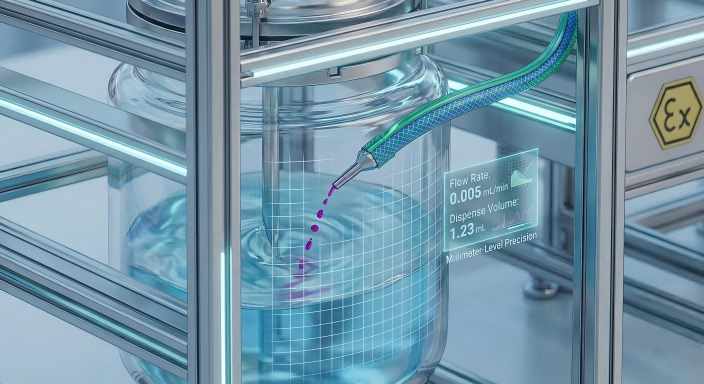
Achieving Millimeter-Level Precision in Hazardous Zones

Safety is the baseline, but precision is the competitive edge. Modern explosion-proof peristaltic pumps leverage advanced drive technologies to ensure volumetric accuracy.

High-Subdivision Stepper and Frequency Drives

By employing micro-stepping technology or high-precision frequency converters, these pumps can achieve a speed resolution of 0.1 RPM. This enables the catalyst to be added to micro-reactors or large synthesis tanks in a stable, drop-by-drop manner. Unlike diaphragm pumps that may exhibit significant pulsations, the multi-roll peristaltic pump head can minimize flow rate fluctuations, thereby providing nearly linear flow rates.

Explosion Proof Peristaltic Pump for Chemical and Pharma Processes In the pharmaceutical sector, flammable and explosive organic solvents (like methanol, ethanol, and ethyl acetate) are often employed in the manufacturing process. Such fluids are typically characterized by their volatile nature and flammability. They will lead to an explosion or fire hazards in a sealed or unventilated condition due to electrostatic discharge. With the increased scrutiny from regulatory bodies like the FDA and EMA on safety and cross-contamination protocols, the choice of liquid transfer systems has become an essential decision-making process for companies. The trade-off between explosion-proof safety and operational efficiency is the primary issue that pharmaceutical companies face. Pharmaceutical Intermediate Production Three Critical Challenges in Pharmaceutical Intermediate Production Drug intermediates are very important raw materials in drug synthesis processes. The purification level of drug intermediates plays an important role in determining the efficiency of active ingredients of drugs. For example, in the process of producing antitumor drugs and antibacterial agents, intermediates require extremely high demands for temperature, pressure, and solvent metering accuracy during reactions to guarantee the stability of reactions and consistency of products. However, the strong acids, strong bases and flammable solvents commonly encountered during the production process pose three major core challenges: 1. Extreme Explosion Risks and Compliance Pressure Most of the intermediate reactions involve high concentrations of flammable solvents, such as methanol, toluene, ether, and tetrahydrofuran (THF). These substances have low flash points and high volatility, creating an environment classified as Zone 1 or Zone 2 hazardous area. Any equipment capable of generating an electric spark, static discharge, or excessive surface temperature could potentially become a ignition source. Meeting international explosion-proof standards (such as ATEX in Europe or CNEx in China) is not only a regulatory requirement but also a fundamental safety requirement. 2. Chemical Corrosion and the "Zero Leakage" Mandate Pharmaceutical intermediates usually have corrosive properties and involve strong acids, strong bases or highly reactive organic compounds. Traditional centrifugal pumps or gear pumps rely on mechanical seals or packing, and these components are well-known as weak points prone to failure. Once the seal fails, "operation, discharge, dripping or leakage" situations will occur, resulting in costly material losses, environmental pollution and personnel casualties. Moreover, the pharmaceutical industry strictly adheres to Good Manufacturing Practice (GMP) for drug production, which requires the use of equipment that can be quickly cleaned (CIP) to prevent contamination between batches. 3. Precision Dosing for Yield Optimization Many intermediate synthesis processes, such as catalytic hydrogenation or Grignard reactions, are highly exothermic and concentration-sensitive reactions. The rate of reagent addition must be controlled within ±0.5% or less. Minor fluctuations in flow rate (usually caused by internal slippage in traditional pumps) can lead to local overheating, increased side reactions, and a significant drop in the purity of the final product. fluid transfer As the pharmaceutical industry imposes increasingly strict requirements on safety and quality, choosing compliant and efficient explosion-proof equipment has become an inevitable choice for enterprises. How Explosion Proof Peristaltic Pumps Solve the Safety Equation An Explosion Proof Peristaltic Pump is specifically engineered to neutralize the risks mentioned above through three layers of protection: The Flameproof Enclosure The core components of the system are explosion-proof induction motors or dedicated brushless DC motors. These motors are installed within a sturdy and durable housing, which is designed to prevent internal explosions and prevent flames from leaking into the surrounding environment. The connectors and cable entrances have been precisely machined to ensure that any escaping gas is cooled to a temperature lower than the ignition point of the external environment. Total Fluid Isolation The working principle of the peristaltic pump is "unsealed". The fluid is completely enclosed within a flexible and high-performance pipeline, and does not come into contact with the pump head, rollers or drive shaft. This eliminates the need for mechanical seals, enabling the pump to achieve 100% leak-proofing. For pharmaceutical chemists, this means a "clean" flow path, thereby simplifying verification and maintenance tasks. Static Dissipation and Surface Temperature Control In hazardous areas, the friction between the pump rollers and the pipes can generate static electricity. The professional explosion-proof system uses conductive or anti-static pipes to safely discharge the static electricity to the ground. Additionally, these pumps have specific temperature ratings (typically T4), ensuring that the external surface temperature does not exceed 135°C even under heavy load conditions. Achieving Millimeter-Level Precision in Hazardous Zones Safety is the baseline, but precision is the competitive edge. Modern explosion-proof peristaltic pumps leverage advanced drive technologies to ensure volumetric accuracy. High-Subdivision Stepper and Frequency Drives By employing micro-stepping technology or high-precision frequency converters, these pumps can achieve a speed resolution of 0.1 RPM. This enables the catalyst to be added to micro-reactors or large synthesis tanks in a stable, drop-by-drop manner. Unlike diaphragm pumps that may exhibit significant pulsations, the multi-roll peristaltic pump head can minimize flow rate fluctuations, thereby providing nearly linear flow rates. explosion proof peristaltic pump​ Closed-Loop Integration (DCS/PLC) In modern pharmaceutical factories, pumps are rarely standalone units. Explosion-proof pumps are equipped with isolation signal interfaces (4-20mA, RS485/MODBUS), enabling them to be integrated with explosion-proof mass flow meters or weighing equipment. If the viscosity of the intermediate in the reaction process changes, the PLC can automatically adjust the pump speed to maintain a constant mass flow rate. This process is called PID control. Tubing Resilience and Chemical Compatibility Accuracy also depends on the "memory" property of the pipe material. During the intermediate production stage, the pipe must be able to withstand solvents such as DMF or DCM without expanding. Expansion would change the inner diameter of the pipe, thereby directly affecting the flow accuracy. Using high-purity, solvent-resistant pipe materials (such as Viton or special thermoplastic elastomers) ensures stable flow during hundreds of hours of operation. The process of producing intermediate pharmaceuticals is a delicate balance involving risk management. The explosion-proof peristaltic pump is more than just equipment; it is also an important safety precaution and precision tool. Through its ability to prevent leaks, manage possible sources of ignition, and deliver digital flow control, this innovation allows companies not only to ensure safe manufacturing processes but also to improve the efficiency and quality of their output.


Closed-Loop Integration (DCS/PLC)

In modern pharmaceutical factories, pumps are rarely standalone units. Explosion-proof pumps are equipped with isolation signal interfaces (4-20mA, RS485/MODBUS), enabling them to be integrated with explosion-proof mass flow meters or weighing equipment. If the viscosity of the intermediate in the reaction process changes, the PLC can automatically adjust the pump speed to maintain a constant mass flow rate. This process is called PID control.

Tubing Resilience and Chemical Compatibility

Accuracy also depends on the “memory” property of the pipe material. During the intermediate production stage, the pipe must be able to withstand solvents such as DMF or DCM without expanding. Expansion would change the inner diameter of the pipe, thereby directly affecting the flow accuracy. Using high-purity, solvent-resistant pipe materials (such as Viton or special thermoplastic elastomers) ensures stable flow during hundreds of hours of operation.

The process of producing intermediate pharmaceuticals is a delicate balance involving risk management. The explosion-proof peristaltic pump is more than just equipment; it is also an important safety precaution and precision tool. Through its ability to prevent leaks, manage possible sources of ignition, and deliver digital flow control, this innovation allows companies not only to ensure safe manufacturing processes but also to improve the efficiency and quality of their output.