
How Does Liquid 3D Printing Work? – Explained in Detail
With additive manufacturing (3D printing) technology constantly evolving, liquid 3D printing has quickly broadens its applications into areas such as biology, food, ceramics, and functional materials.
Unlike standard FDM (Fused Deposition Modeling) or SLA (Stereolithography) processes, liquid 3D printing centers around extruding fluid, and this also places more stringent demands on fluid control systems. The following is a full introduction on how does liquid 3D printing work. Let’s go!
Part 1. What is Liquid 3D Printing?
Liquid 3D printing, or fluid additive manufacturing, refers to the technology to build three-dimensional structures layer by layer by means of extruding liquid, paste-like, or gel-like materials.
Compared to traditional printing technologies that are solid-state material-based, it has the capability to print a wider range of materials such as bioinks, hydrogels, food pastes, ceramic slurries, and even conductive pastes.
The key to this print technology is precise control and constant release of liquid material, in a manner that allows the material to maintain its shape after being extruded and gradually solidify.

Part 2. How Does Liquid 3D Printing Work?
The general process of liquid 3D printing involves several significant steps, all crucial to building precise and stable 3D structures:
1. Material Preparation
It begins with the processing of the liquid material suitable for the application at hand. The materials may be anything from bioinks for tissue engineering, food paste for customized food products, ceramic slurries for high-tech ceramics, or conductive inks for electronic materials.
Pre-treated material is kept in a reservoir, say cartridge, syringe, or tube that keeps the material stable and free from any sort of contaminants.
2. Fluid Delivery
Proper fluid flow is essential. Pumps, usually peristaltic pumps, are employed to control pressure and the rate of liquid material as it moves from the reservoir to the printer nozzle.
Peristaltic pumps are used because they can give accurate, pulsation-free flow control and reduce the risk of material contamination by not having direct contact with pump components. The pump’s control system precisely adjusts the speed of extrusion to meet the printing requirement and gives smooth, uninterrupted material flow.
3. Path and Motion Control
The print head is moved along a pre-computed path based on digital 3D models. The movement is controlled with the help of CNC systems or robots, which guide the nozzle in layers.
As the nozzle traverses its programmed path, it distributes the liquid material in a predetermined sequence to form the shape of the object. Print speed and layer thickness are carefully adjusted so that dimensional fidelity and surface finish are maintained.
4. Solidification and Curing
After extrusion, the material must solidify to retain the intended shape and provide structural integrity. Depending on the material type, various curing methods are employed:
- Air drying for materials that harden upon solvent evaporation.
- Heating to induce thermal curing or phase transitions.
- Ultraviolet (UV) light exposure for photo-polymerizable materials.
- Chemical reactions initiated by additives or crosslinkers within the material.
The curing step is often synchronized with the printing process, either occurring layer-by-layer or after the entire structure is formed, to avoid deformation or collapse.

5. Feedback and Control Systems
During printing, flow rates, pressure, and nozzle conditions are monitored by sensors and feedback systems. Real-time data is used to effect dynamic adjustments so that extrusion is uniform and faults such as clogging, dripping, or uneven layering are eliminated.
Liquid 3D printing is very reliant on there being a high-precision fluid control system available to offer smooth extrusion of the liquid material, maintain shape integrity immediately after deposition, and harden to form intricate and functional three-dimensional structures.
Part 3. General Application Fields of Liquid 3D Printing
Liquid 3D printing is unmatched in process versatility and material compatibility and hence can be applied to a very wide range of industries and applications:
1. Biomedical Field
Liquid 3D printing finds its application in biomedicine for the fabrication of tissue engineering scaffolds and organ models by the use of bioinks and hydrogel extrusion. They are designed to mimic structure of the extracellular matrix and enhance cell growth and tissue regeneration.
2. Food Industry
Liquid 3D printing allows the precise layering of foods such as chocolate, cream, dough, and purees. This aspect allows for the preparation of personalized foods with intricate designs, tailored texture, and novel flavor profiles. It is advantageous for advances in personalized nutrition and artisanal food preparation.
3. Ceramic Manufacturing
High-viscosity ceramic slurries can also be printed into intricate, highly detailed shapes that prove hard to produce with conventional molding or machining. The ceramic parts after being printed are subjected to sintering operations to produce dense high-strength components employed in aerospace, electronics, and biomedical implants.

4. Electronics Fabrication
Liquid 3D printing enables conductive ink and flexible circuit materials to be printed layer-by-layer. This can be highly beneficial in producing wearable technology, foldable sensors, and other next-generation electronics that must be capable of creating intricate geometries and custom electrical pathways.
5. Cosmetics and Pharmaceuticals
The technology is further used for the printing of creams, gels, and other topical drugs with customized shapes and dosages. This enhances user satisfaction with customized skincare and drug targeting, which improves efficacy as well as convenience.
Part 4. Major Equipment in 3D Printer: Peristaltic Pumps
Sustained and accurate material transport is very important for successful print outputs in liquid 3D printing systems. In relation to pneumatic or syringe-based systems, peristaltic pump is especially better suited to handle a wide range of high-viscosity and sensitive liquids in the printing system.
Why Choose Peristaltic Pumps?
Non-Contact Delivery:
The fluid only comes into contact with the interior surface of the soft tubing, eliminating cross-contamination or cross-reaction with pump components. This is critical in material purity assurance, especially in biomedicine and food-grade use.
High-Precision Control:
The rate of flow is controlled by simply adjusting the rotation speed of the pump, enabling stable and consistent extrusion even of highly minute amounts of material. The high-precision control enables consistent quality of layers and dimensions in printed parts.
Gentle Handling:
Fluid is transferred by peristaltic pumps by compressing the tubing without exposing materials to direct shear forces, preserving shear-sensitive materials such as living cells, bioinks, and sensitive gels in their original condition.
Convenient Material Changing:
Material change is simply a matter of exchanging the tubing, without the need to break down or clean the pump itself. This minimizes time and contamination risk in changing liquids or batches.
As a result of these advantages, peristaltic pumps have become the go-to solution in applications like bioprinting and food printing where sensitivity to the material and cleanliness are critical.
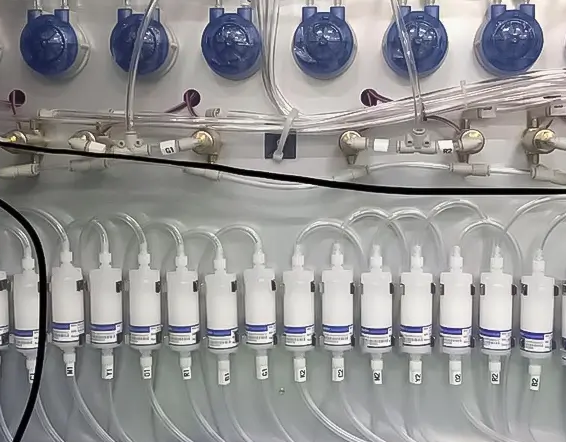
Advantages of peristaltic pumps for liquid 3D printing
- High Stability: Resistant to air pressure variation, resulting in smooth and consistent material flow.
- Broad Material Support: Across a broad range of viscosities, from liquids to thick pastes, accommodating a broad range of print materials.
- Easy Installation: Minimalist design makes it easy to integrate into various 3D printer models and configurations.
- Hygienic and Safe: For medical, food, and laboratory use due to the absence of any route of contamination of fluids.
Wrap Up
Liquid 3D printing is transforming manufacturing across numerous high-precision industries, and as an important component of its control system, the peristaltic pump provides reliable assurance of precise extrusion of fluid material. Whether you are working on medical devices, biological research, food, ceramics, or developing new materials development, the mastery of fluid control technology holds the secret of print quality.
If you require peristaltic pump solutions for liquid 3D printing, do not hesitate to reach out to JIHPump. We offer highly accurate, highly stable pump control systems ensure efficient and effective 3D printing for you.