
Do More Rollers Mean Better Performance in a Peristaltic Pump?
Some people say, “The more rollers there are, the better the pump is.” It sounds reasonable – more rollers, smoother flow and higher precision, but is that really the case?
The answer is: Not necessarily.
In fact, the relationship between the number of rollers and the performance of peristaltic pumps is very complex. The number of rollers will affect pulsation, the lifespan of the pump tube, flow capacity, motor torque requirements and long-term maintenance costs. The selection of the number of rollers is actually an engineering game about “smoothness, lifespan and cost”.
Do More Rollers Mean Better Performance in a Peristaltic Pump?
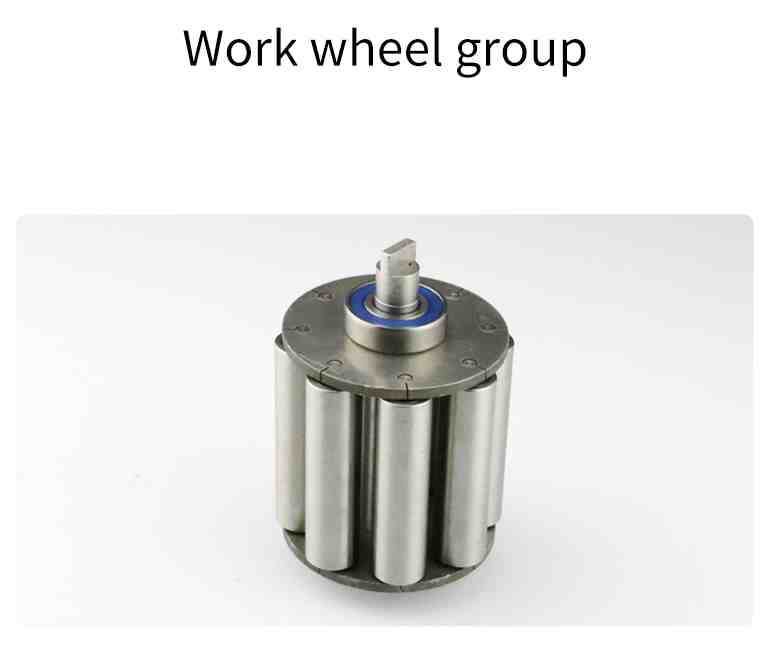
To understand the influence of the number of rollers, it is first necessary to understand the working principle of peristaltic pumps.
- The rollers press the silicone or TPE tubes towards the pump casing.
- When the roller rotates, it will push a small section of fluid to flow forward.
- Durin the gap between the alternating movements of the rollers, the fluid in the tube naturally flows back, generating tiny pressure fluctuations, which is called pulsation.
More rollers = more compression points per rotation
This reduces the fluid volume between each compression event, thereby resulting in:
- The fluid is more stable and has higher precision
The fluid pulsation is significantly reduced. The more rollers there are, the more times the hose is squeezed per revolution. The flow output is composed of more and smaller “peaks” superimposed, making the overall flow smoother.
This is of vital importance in scenarios such as chromatographic analysis and cell culture where pulsation is extremely sensitive.
- Short-term flow accuracy is higher
The fluctuation becomes smaller and the instantaneous flow rate is more stable.
It is suitable for experiments or detection systems that have extremely high requirements for short-term quantitative accuracy.
But more wheels also mean some trade-offs:
- The lifespan of the hose is shortened: At the same rotational speed and compression depth, more rollers often mean an increase in the number of compression cycles per unit time, thereby accelerating aging.
- Increased operating heat: More rollers = more friction points, which will generate more heat. This not only accelerates the aging of the hose, but also may cause performance deviations or stability issues when transporting temperature-sensitive fluids.
- The structure is complex and the cost is higher: More rollers mean a more complex pump head structure, more parts and a larger volume, which usually directly translates into higher manufacturing costs and larger equipment.
Therefore, engineers must assess whether more rollers are truly beneficial to the application or will introduce unnecessary complexity.
Suitable Applications for Different Roller Counts
When we understand the advantages and disadvantages brought by the number of rollers, the real key becomes: In your work project, what is the most important?
Choose based on the usage scenario: There is no best, only the most suitable. Different configurations of peristaltic pump roller numbers are suitable for different application scenarios.
Suitable for Pump Heads with Fewer Rollers (2 to 3 Rollers)
Core requirements: Hose lifespan and economy
Typical scenarios: industrial continuous filling, water treatment dosing, etc
Reason: Slight pulsation usually does not affect the process outcome, but frequent replacement of hoses can cause downtime and increase the cost of consumables. At this point, “longer lifespan” is often the better solution.
Suitable for Multi-roller Pump Heads ( 4 to 8 Rollers)
Core requirement: Fluid stability
Typical scenarios: Precision analytical instruments (HPLC), cell perfusion, etc
Reason: Even the slightest fluctuation in flow rate may interfere with the detection signal or reaction efficiency. In this type of application, “stability” is the top priority.
Practical Solutions When Roller Count Can’t Meet Your Requirements
However, in practical applications, if the number of rollers is simply increased, many applications still cannot achieve an ideal balance among flow rate, pulsation stability, durability and cost. So how should we solve it?
Solution 1: Use a Single Pump Head with Multi-Channel (Multi-Roller) Design
This scheme does not combine low-roller and high-roller pump heads, but adopts a single-pump head multi-channel design, with each channel equipped with an independent roller group.
How it works
- Multiple channels operate within a single pump head housing
- Each channel has its own independent roller assembly
- Channels can be used independently or simultaneously
- If necessary, the phase of the channels can be adjusted to achieve a smoother combined output
Advantage
- Increase the total flow rate (when channels are operating in parallel)
- Compared with single-channel pumps, it has less pulsation
- It is more compact than installing two independent pump heads
- Modular design, easy to integrate into OEM equipment
- It is highly suitable for fluid diversion, mixing or multi-reagent transportation
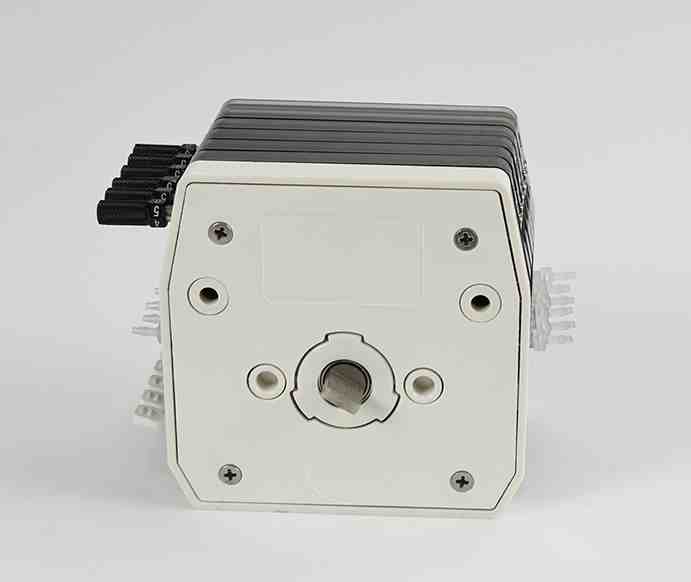
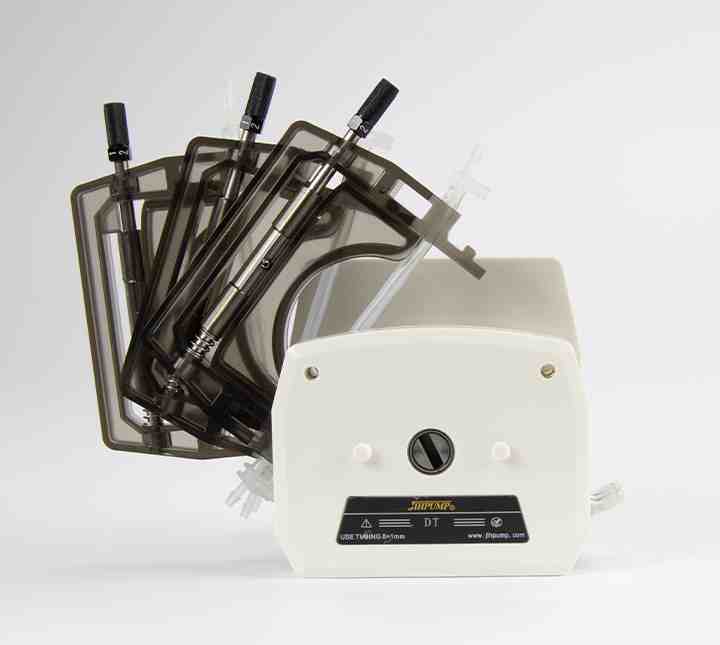
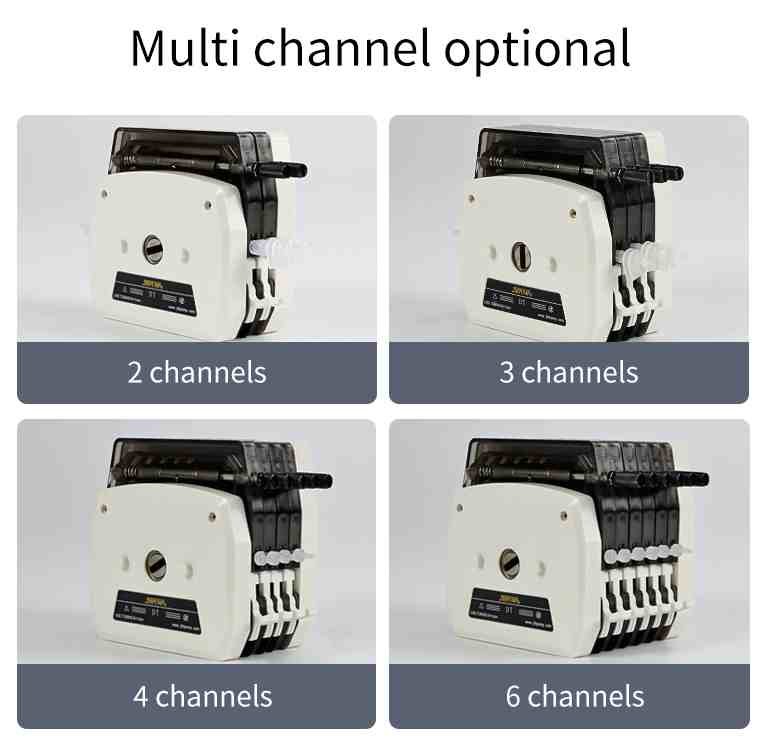
The DT multi-channel easy load peristaltic pump heads provided by JIHPUMP adopts precise molding technology and industrial-grade design to ensure outstanding performance and durability. Its dust-proof back cover raises the hygiene standards, and the convenient installation design simplifies the assembly and disassembly of pipelines. This pump head is compatible with multiple structures, including OEM bracket-type peristaltic pumps and complete pump systems, and can flexibly adapt to different application requirements. It supports pipes with a wall thickness of 1mm and offers three configurations: 1×1, 2×1 and 3×1, as well as optional configurations of 2, 3, 4 and 6 channels. It also supports two pump heads in series, significantly enhancing the flexibility and efficiency of fluid transportation.
Solution 2: Customized Roller Count Pump Heads
Some applications do indeed require specific roller configurations, especially in the following areas:
- High-end analytical equipment
- Micro-drug delivery system
- Medical-grade infusion module
- Precision reagent pump
Customizing the number of rollers enables engineers to precisely match:
- The required pulsation level
- Flow velocity capacity
- Pressure demand
- Pipe compatibility
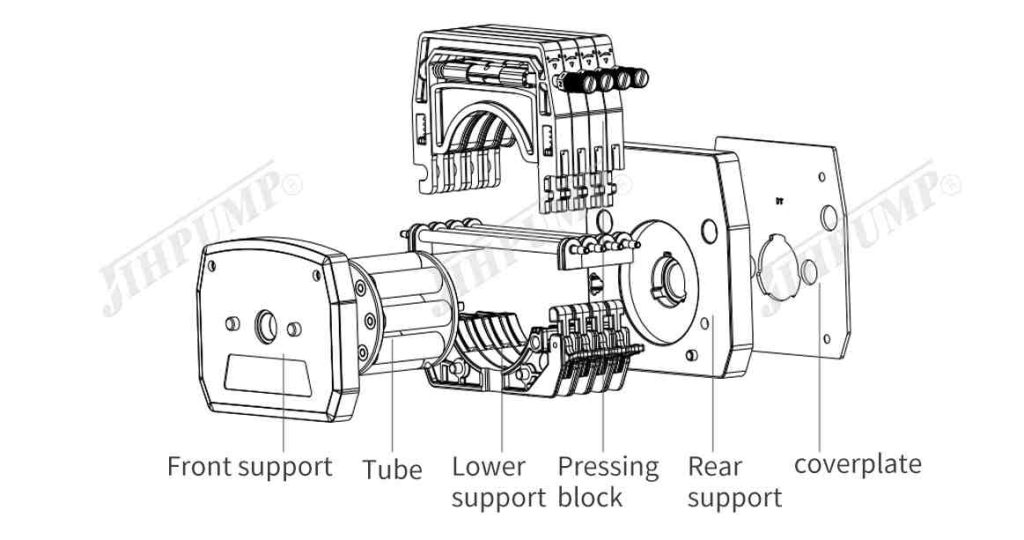
For special high-precision requirements, we offer customizable peristaltic pump heads with an adjustable number of rollers to optimize ultra-low pulsation and stable microflow output.
Conclusion: Roller Count Is Not the First Priority—System Design Matters More
The number of rollers of a peristaltic pump is the optimal choice made after weighing “flow stability”, “hose lifespan”, “operating cost” and “system complexity” under specific application requirements.
Therefore, when making a selection, please be sure to consider: In my process, is stability more important, or is reducing downtime and lowering material costs more crucial?
If you still face a choice in the actual selection process, the JIHPUMP business team can provide you with one-on-one professional selection analysis. By combining your fluid characteristics, flow range and budget, we can find a truly efficient, reliable and economical solution for you.