
How Peristaltic Pumps Are Used?
A peristaltic pump is a device used for the accurate and stable delivery of liquids. Its working principle is as follows: when rotating rollers squeeze the pump tubing, a sealed chamber forms inside the tubing, pushing the liquid forward. When the rollers release the tubing, the tubing returns to its original shape and draws in new liquid. By repeating this cycle of squeezing and releasing, the pump continuously transfers liquid. The flow rate of the liquid can be precisely controlled by adjusting the rotational speed of the rollers.
The main functions of a peristaltic pump are quantitative / metered delivery and quantitative / metered dispensing. Therefore, it can be used in any application that requires controlled liquid delivery or dosing.
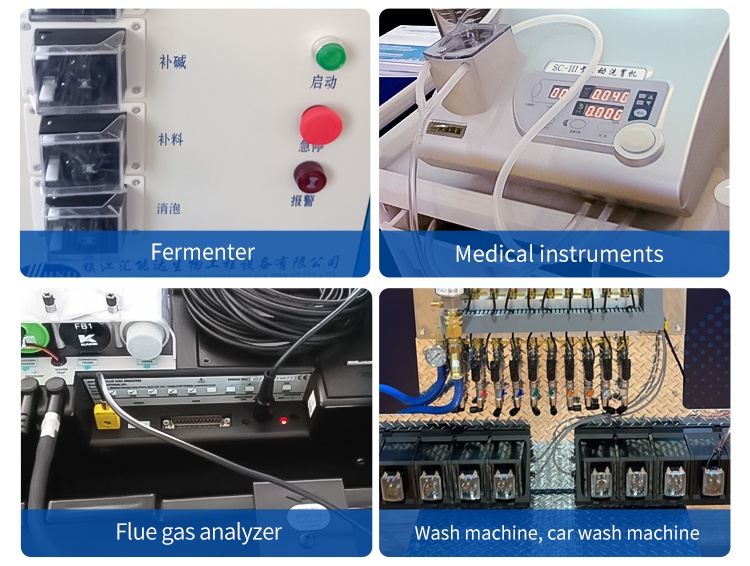
For example, peristaltic pumps are applied in flue gas analyzers to transfer corrosive media or liquids containing solid particles. They stably extract condensate in flue gas analysis, ensuring a steady and reliable supply of flue gas samples for the system.
Peristaltic pumps are also widely used in beverage dispensers. They can accurately meter and dispense beverages, guaranteeing consistent volume for each serving. Since the liquid only contacts the clean pump tubing with no dead zones, the delivered beverages fully meet food safety requirements. With its low shear force, a peristaltic pump causes little damage to beverage ingredients, preserving the original quality.
It also minimizes liquid residue and contamination, supporting high hygiene standards. The pump has strong self-priming capability and adaptability, handling beverages of various viscosities for a wide range of applications. Compared with other pumps, it is easier to maintain due to its relatively simple structure.
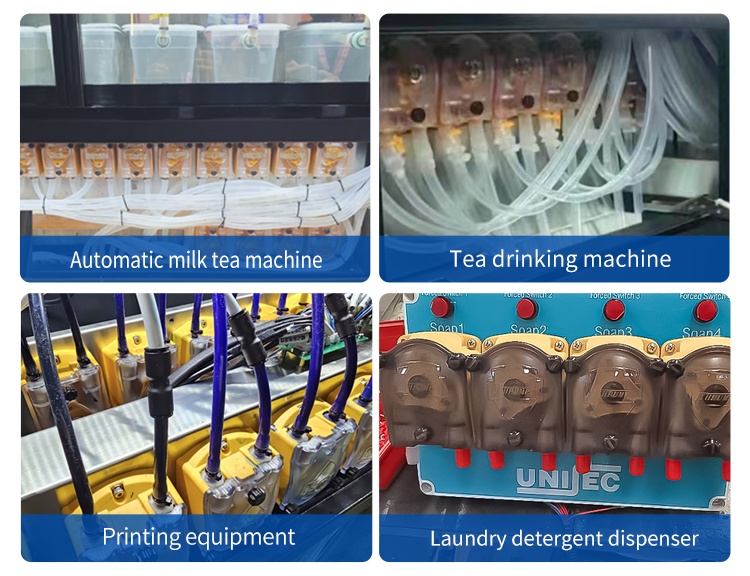
In addition to analytical instruments and the food & beverage industry, peristaltic pumps are widely used in many fields, including: medical diagnosis and treatment, pharmaceutical industry, environmental monitoring, biochemical analysis, advertising inkjet printing, washing industry, small household appliances, laboratories of scientific research institutes, industrial fluid equipment, and more.
Some equipment manufacturers choose low-cost diaphragm pumps, but they are not suitable for every scenario. Peristaltic pumps and diaphragm pumps work differently:
- A peristaltic pump transfers liquid by squeezing the pump tubing with rollers.
- A diaphragm pump moves liquid by changing the volume of the pump chamber through the reciprocating motion of a diaphragm.
In terms of sealing performance, peristaltic pumps offer excellent sealing. While diaphragm pumps also have good sealing, they may carry a risk of leakage under certain conditions. The two pumps also affect liquids differently: peristaltic pumps exert low shear force, making them ideal for sensitive liquids; diaphragm pumps may generate relatively higher shear force on the liquid.