
Peristaltic Pumps in Noodle Machines: Enhancing Noodle Production Efficiency and Food Safety
In the noodle manufacturing industry, ranging from handmade noodle preparation in home kitchens to large-scale industrial production, water dosage is always the core factor that determines noodle texture. Soft wheat noodles require moderate water addition, buckwheat noodles need more water, and whole wheat noodles demand highly precise water proportioning. Any deviation in water volume will either cause dough sticking to equipment, or lead to broken noodles and overly firm texture.
Traditional water supply methods for noodle machines have long been plagued by three major drawbacks: manual water addition relies heavily on personal experience, centrifugal pumps are prone to residual contamination, and gear pumps fail to deliver accurate flow regulation. The introduction of peristaltic pumps has brought precise, hygienic and fully automatic solutions to the water feeding process of noodle making equipment.
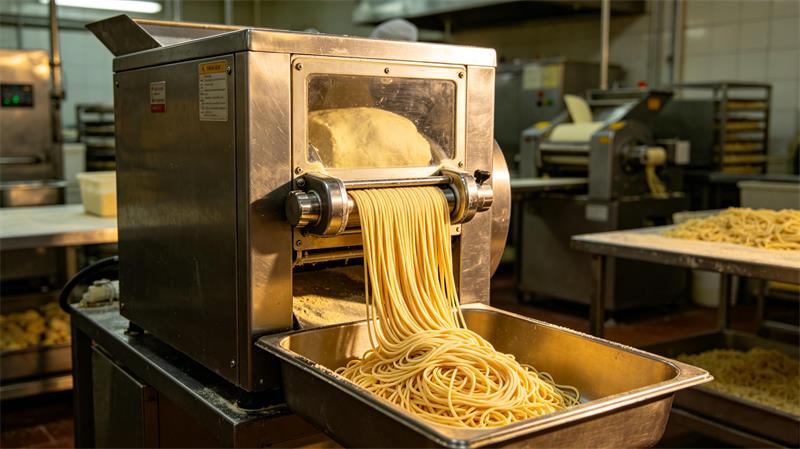
Three “Fatal Flaws” of Traditional Noodle Machine Water Pumping Systems
During the process of automation upgrading, many noodle machine manufacturers attempted to use traditional fluid pumps. However, numerous drawbacks quickly emerged during actual operations:
Hygiene Hazards (Centrifugal Pumps):
The impeller structure of centrifugal pumps is highly prone to accumulating limescale residues or backflow noodle batter. Moreover, it contains numerous cleaning blind spots that easily breed bacteria, making it difficult to pass strict food safety audits.
Medium Contamination (Gear Pumps):
The mechanical seals and lubricating oil inside gear pumps pose a continuous risk of leakage over long-term operation. Once the dough is contaminated, the entire batch of products faces scrap.
Lack of Precision (Traditional Pumps):
The flow rate of traditional pumps fluctuates significantly with pressure changes, failing to achieve micro-level, constant, and precise delivery. This results in unpredictable moisture content in the dough, making it difficult to achieve standardized production quality.
Core Technical Advantages of Peristaltic Pumps for Noodle Machines
As a positive displacement pump featuring non-contact fluid transmission, the structural design of peristaltic pumps perfectly meets the water supply requirements of noodle machines, operating on the core principle of fluid delivery via flexible tubing compression with accurate flow regulation.
1. Non-contact transmission to avoid contamination
Only food-grade tubing comes into direct contact with water, while main pump components such as motors and rollers stay completely isolated from liquid. This design eliminates dirt accumulation inside centrifugal pump impellers and liquid leakage from gear pump seals, fully complying with strict food production hygiene standards.
2. Accurate flow control to match different formulas
Driven by stepper motors, peristaltic pumps achieve flow control accuracy within ±2%. The flow range covers a minimum of 0.1 mL/min up to 150 L/h. Whether it is small-batch home noodle production using 200 grams of flour or industrial production lines processing 100 kilograms of flour per hour, complete models of JIHPUMP peristaltic pumps can deliver accurate water volume matching different production demands.
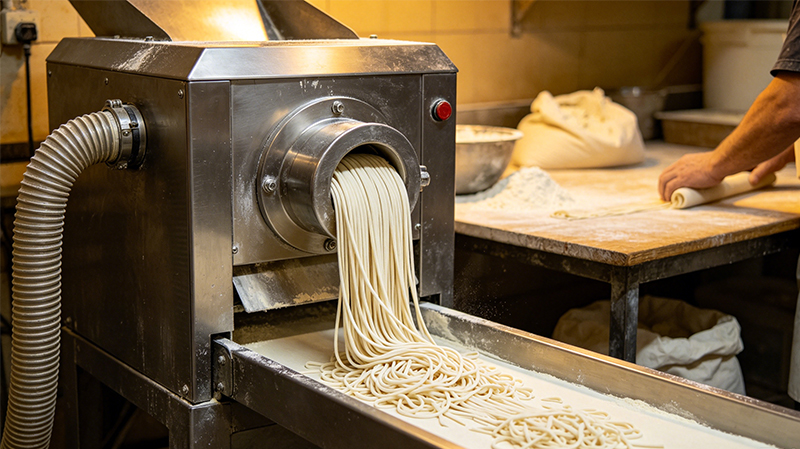
3. Clogging resistance and easy maintenance to reduce operational loss
The elastic tubing allows tiny impurities such as flour particles and scale inside water to pass through smoothly without blockage. Tubing is the only vulnerable part, which can be replaced within two minutes by a single operator without disassembling the entire pump unit.
Furthermore, peristaltic pumps can be perfectly connected with noodle machine control systems, realizing integrated automatic procedures including flour feeding, water volume calculation, automatic water suction and synchronous water filling, eliminating uncertainties caused by manual operation.
Core Technology Comparison: Peristaltic Pumps vs. Traditional Transfer Pumps
| Evaluation Dimension | Traditional Centrifugal / Plunger Pumps | Traditional Gear Pumps | Jiheng Food-Grade Peristaltic Pumps |
| Food Safety / Contamination Risk | High (Impeller easily accumulates scale; contains cleaning blind spots) | Medium (Risk of lubricating oil/mechanical seal leakage) | Extremely Low (Fluid only flows through the tubing; zero-contact) |
| Flow Control Precision | Poor (Significantly affected by pipeline pressure fluctuations) | Average (Incapable of achieving micro-level, ultra-precise control) | Extremely High (Up to $\pm1\% \sim \pm2\%$) |
| Multi-Medium Adaptability | Limited (Restricted to clean water; highly susceptible to wear from impurities) | Poor (Viscous liquids or micro-particles can easily jam the gears) | Strong (Easily transfers vegetable juice, egg liquid, and brine) |
| Daily Cleaning & Maintenance | Complex (Requires pump body disassembly; extremely tedious to clean) | Difficult (High maintenance difficulty and costly seal replacements) | Extremely Simple (Requires only backflushing or a 2-minute tubing replacement) |
Final Thoughts
For noodle making machines, peristaltic pumps act as precise regulators to stabilize noodle taste, effective tools to cut production waste, and key equipment driving the noodle industry from experience-based production to standardized manufacturing. They deliver ideal solutions for household users pursuing simple and delicious homemade noodles, as well as industrial clients aiming at cost reduction and efficiency improvement, thus becoming essential core components in modern noodle production.
With a comprehensive product lineup, JIHPUMP fully covers fluid handling demands from large commercial catering equipment to compact household appliances. Supported by abundant practical experience in the food and beverage industry, we focus on customized OEM peristaltic pump solutions and provide accurate, reliable and professional services for customers worldwide.