
The OEM Design Guide: Selecting the Right Panel Mount Peristaltic Pump for Precision Systems
When you’re spec’ing out precision instruments these days, the panel mount peristaltic pump is quickly edging out traditional benchtop models as the tight space solution. But honestly, a lot of engineers get stuck on the same two questions right away. First, how do you pull off accurate micro volume dosing when the enclosure is already crammed full? And second, how do you make routine maintenance so easy that your end user never has to call for help?
This guide walks you through what really sets a panel mount pump apart, breaks down the quick mounting mechanisms that save assembly time, digs into motor and flow control choices, and shows you how to think about maintenance from an OEM perspective. By the end, you’ll have a much clearer picture of what to look for when you need that perfect fluid handling fit for your system.
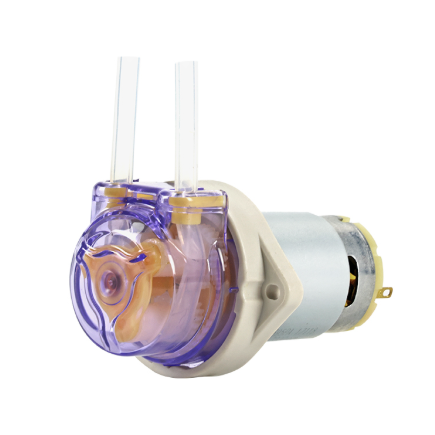
Panel Mount Peristaltic Pump: How It Differs from Standard Models
In most labs, the peristaltic pump you see is a benchtop unit. It looks like a small box, has its own housing, a little screen, and some buttons. You take it out of the box, plug it in, and it’s ready to go.
A panel mount peristaltic pump is a completely different animal. Think of it as a dedicated fluid handling device that gets embedded directly into your equipment chassis, secured to the front panel or an internal bracket, with all the extra outer casing stripped away. At their core, both types move liquid by squeezing a flexible tube with rollers. But the way they exist inside a system is night and day.
If a benchtop pump is like a laptop, self contained with its own keyboard and display, a panel mount pump is more like a blade server card you slide into a rack. The benchtop model shines when you need standalone operation and quick manual adjustments. The panel mount version, on the other hand, is born to be embedded. It ditches the unnecessary frame and enclosure, organizes the mounting holes, the control electronics, and the drive motor into the tightest possible layout, so you can lock it straight into your analytical instrument, monitoring cabinet, or vending machine. It becomes the execution core, not an add on.
This embedded design approach, where a component becomes an inseparable part of the whole system, keeps the exterior clean and the interior layout efficient. That’s exactly the kind of compact, refined build that modern industrial products aim for.
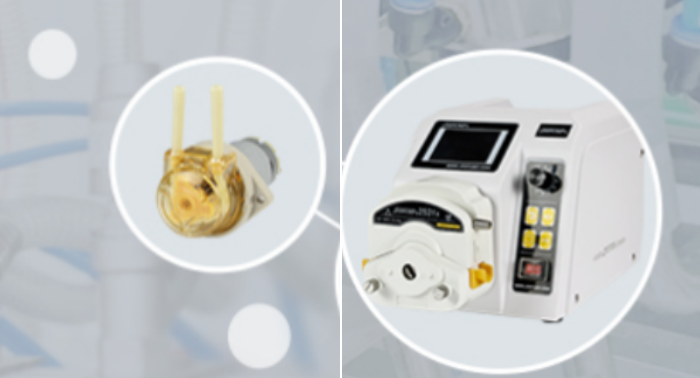
To make the distinction even clearer, here’s a quick side by side comparison of the two:
| Comparison Point | Benchtop Pump | Panel Mount Peristaltic Pump |
| Size & Form Factor | A self contained box with its own housing, display, and buttons. Takes up a fair amount of space. | Only the pump head and drive circuit are present. Very compact, like a fluid handling card you can slot into a chassis. |
| Installation | Placed on a bench or secured with a simple bracket. Just plug it into an outlet. | Requires a cutout on the equipment’s front panel. The pump is pushed in from the outside and locked into place, becoming a permanent part of the machine. |
| Control Logic | Has its own control panel for manual speed and start/stop. Higher end models can be controlled via communication interfaces. | No separate control panel. It must be controlled by a system’s master board (the brain of the equipment, such as a microcontroller or PLC) sending analog signals or digital commands. |
| Typical Application | Lab scale experiments, short term projects, situations where you need to tweak the flow by hand frequently. | OEM equipment produced in volume, like in vitro diagnostic analyzers, water quality monitoring stations, and automated dispensing machines. |
Why Your Equipment Needs a Panel Mount Peristaltic Pump
So why not just tuck a full benchtop pump inside your machine? The answer really comes down to one word: integration.
First off, it saves a ton of precious internal space. Inside your IVD device or water monitoring cabinet, there are circuit boards, sensors, and reagent bottles, all fighting for room. A panel mount pump sheds that bulky external housing, shrinking its footprint considerably. This lets your industrial design breathe a bit, without being choked by a pump that’s bigger than it needs to be.
Second, the electrical side gets a lot more compatible. Higher end panel pumps typically speak standard industrial protocols. You can hook them up via an RS485 interface, which is a robust serial communication standard that works over long distances with good noise immunity, or use an analog signal, where a varying voltage or current, like 0 to 5 V or 4 to 20 mA, directly controls the pump speed. The pump talks straight to your system’s main controller without needing a bunch of external relays just to turn it on and off. That makes programming more stable and way more responsive.
And third, there’s the professional look factor. When an end user sees a peristaltic pump seamlessly integrated right into the equipment’s front panel, it gives off a sense of unified, precision design. That’s a world apart from having an external box dangling off the side of an expensive instrument.
Improving Efficiency with Quick-Mounting Panel Mount Peristaltic Pumps
If a panel mount design solves the space issue, then quick mounting takes a big swing at assembly efficiency. Quick mounting, in this context, means a mechanical design that lets you insert and lock the pump from the front of the panel; there’s no need to open up the whole machine.
Think about the old way. A worker has to open the equipment chassis, reach into a cramped space, try to line up screws, and fasten the pump to an internal bracket. It’s slow, it’s awkward, and there’s always a chance of nicking another precision tube in the process.
A quick mount panel pump flips that script with a “front insert, panel lock” approach. You cut a rectangular hole in the equipment’s front panel according to the spec sheet, push the pump head in from the outside, and secure it with a clip or a locking nut. The mechanical fixing is done, just like that.
This kind of design translates directly into faster assembly throughput, the speed at which you turn parts into a finished product. For an OEM running volume production, shaving 15 minutes off the assembly time for each unit can add up to a serious cost advantage. It also means that later on, swapping out or upgrading the pump is painless. You don’t need to tear down half the machine. Just pull it out from the front of the panel.
Motor and Flow Control in a Panel Mount Peristaltic Pump
Alright, this is the part where a lot of selection mistakes happen. You need to look at two things: the motor type and the control method.
First, the motor. Look for a stepper motor, which is a motor that rotates in very precise, fixed angular steps every time it receives an electrical pulse, kind of like the ticking second hand on a clock. Most compact panel mount pumps use stepper motors built to NEMA 17 sizing, where the mounting face is about 1.7 inches square, roughly the footprint of a slightly thick business card, or NEMA 23, which is 2.3 inches square and delivers more torque.
Why a stepper? Because it gives you the finest possible flow control. Choosing a stepper peristaltic pump ensures that each revolution is divided into hundreds of discrete steps, providing the high precision flow control required for analytical instruments.
A plain DC motor adjusts speed by varying voltage, and its speed can drift when the load changes. A stepper motor, on the other hand, divides each full revolution into hundreds or even thousands of discrete steps. Your controller precisely counts out these electrical pulses, and that gives you high precision flow control. In some demanding panel pump setups, you can get flow resolution down to 0.1 mL per minute or better, and batch to batch repeatability errors can be kept within plus or minus 0.5 percent.
Second, pay attention to whether it has closed loop control. This is where the motor has a built in encoder that constantly feeds back its actual speed. The moment a deviation is detected, the system automatically compensates, just like a thermostat holding a set temperature. This matters enormously for equipment that runs unattended for long periods. When the tubing stiffens with age, or the pumped liquid gets more viscous, increasing the torque load, a regular motor without an encoder might quietly lose a few RPM, and your fill volume drifts. A closed loop stepper motor instantly feels the resistance change and bumps up the current to hold the speed rock steady. Every single reagent addition comes out consistently.
Where to Use a Panel Mount Peristaltic Pump
The range of applications for panel mount pumps is way broader than most people realize. Each one works on a “challenge plus solution” logic. Let’s zoom in on medical in vitro diagnostics, since that’s where the requirements are often strictest, then touch on a few other key fields.
Medical IVD: Tackling Micro Carryover
Inside a chemistry analyzer or a chemiluminescence immunoassay system, the real test isn’t just lifting liquid. It’s dealing with trace reagent carryover. Even a tiny fraction of the last serum sample, a part per million, mixing into the next test can throw the result completely off. Traditional syringe pumps rely on complex multi-way valves, and once those seals start to wear, they become perfect little hideouts for contamination.
The panel mount peristaltic approach is much more straightforward. It uses a fully enclosed fluid path, which means the liquid only ever touches the inner wall of the tubing. It never contacts the rollers or any pump head mechanism. Couple that with a disposable tubing concept, and after each test, the system can run a short rinse cycle or simply auto advance a small section of cheap tubing to get to a fresh segment, effectively resetting the carryover to zero. This “swap the tube” architecture is exactly what medical devices use peristaltic pumps for, allowing IVD manufacturers to embed these modules into their flagship analyzers while keeping contamination risks at zero.
A few other areas to keep on your radar:
Environmental Monitoring: Think about an automatic water quality monitoring station by a river, or a CEMS unit in a stack. The outdoor cabinet has to deal with high humidity and dust year round. This is where you start caring about the pump’s Ingress Protection (IP) Rating, an international scale that tells you how well the enclosure blocks dust and water. An IP65 rating basically means the unit is sealed up like a good rain jacket. Looking for a pump with an IP54 rating or better helps prevent moisture from seeping into the motor and causing a short, keeping those remote stations running long term.
Automated Vending and Beverage Dispensing: In a bean to cup coffee machine, you need to precisely proportion concentrates, syrups, and milk. A quick mount pump can be pulled out for a thorough cleaning in about ten seconds by a staff member, which makes a food safety auditor very happy.
Industrial Dosing and Water Treatment: Circulating water disinfection or boiler chemical dosing systems should adjust the additive flow based on real time sensor feedback. A panel pump driven by a PLC with PID control can hit the target dose dynamically without any human intervention, no overdosing, no underfeeding.
Lab Automation: In automated sample prep workstations for things like solid phase extraction, multiple panel pumps can be packed tightly together in arrays. Each one handles a different solvent, pushing throughput way up.
Maintenance Secrets for Your Panel Mount Peristaltic Pump
As an equipment builder, you can’t just think about the bill of materials cost. You need to consider the customer’s Total Cost of Ownership, which wraps up the purchase price, maintenance downtime, and repairs over the unit’s life.
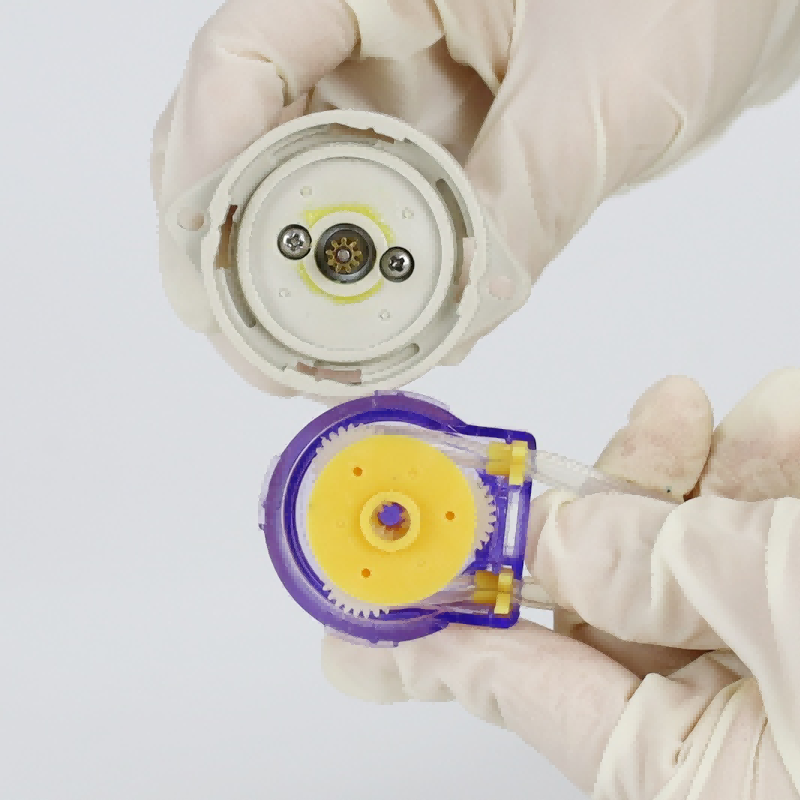
The big selling point of any peristaltic pump is that the only wear item is the tubing. So the whole maintenance game revolves around making tubing swaps tool free.
Check if the pump head has a flip top design, a polymer lid that pops open with a press, not unlike an old cassette tape deck. The ideal workflow is dead simple: the user flicks the latch, lifts the lid, and follows a basic guide of peristaltic pump tube replacement to snap a new tube into the roller track—no tools or special training required. And snaps the lid shut. No screwdriver. No digging inside the cabinet. No special training required.
When you get a sample in your hands for a design review, run through this quick mount evaluation checklist and tick each box:
- Flip top damping feel: Does it open smoothly without springing back wildly? Can you do it comfortably with one hand?
- Tube positioning slot: Does the tubing seat itself naturally into the groove? If you tug on it slightly while it’s running, is there zero chance of it slipping out?
- Drainage and anti backflow design: Is there a drainage channel or a lip seal on the pump head that, if the tubing ever bursts, stops liquid from traveling along the drive shaft into the motor and electronics area?
- Disassembly clearance: When you simulate the tight space inside the real enclosure, can your hand perform the tube change motion without banging into chassis walls?
If you get a high score on these four points, you’ve got a pump that an end user will find genuinely hassle free. It just works, and if something does go wrong, it won’t send them into a panic.
Customizing Your Ideal Panel Mount Peristaltic Pump with JIHPump
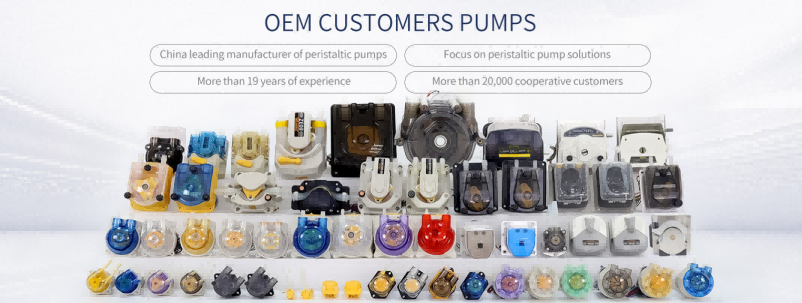
There are plenty of panel mount pump options on the market, but one that really fits your precision device can be surprisingly hard to pin down. So many standard pumps have the wrong rotor dimensions, or the PCB logic doesn’t match your control scheme, or the tubing material options can’t handle that one aggressive solvent in your fluid path.
What you need is a partner who can deliver consistent OEM volume while also dialing in the specifics for your project. JIHPump has built up solid customization experience in the peristaltic pump space.
You can pick from their wide pump head lineup, like the 293KC, 384KC, or 104KA series, and pair it with stepper motors offering different torque ratings along with tailored control interfaces. Whether you’re running on a 24V vehicle power bus or need a custom communication protocol, their engineering team can adjust the torque curve, specify a tubing material that matches your chemical mix, and still hold flow consistency within plus or minus 2% across large production batches.
If off the shelf parts don’t quite lock in with your system requirements, send over your motor specs, your target flow curve, and the exact fluids you’re moving. They’ll approach it like cutting a key specifically for your lock, finding that fluid control core that fits precisely into your equipment panel.