PTFE vs Silicone Tubing for Peristaltic Pumps: 7 Key Differences to Choose the Right Tube
So you’re trying to pick between PTFE vs silicone tubing for your peristaltic pump. It matters more than you might think. Pick the wrong one, and you’ll see flow rates drop, tubes crack, or worse – the pump head jams and the motor burns out.
Let’s cut to the chase. For most standard peristaltic pump applications, silicone tubing is your safe bet. It’s cost-effective, dependable, and it simply works. PTFE tubing is the specialist. You bring it in when you’re pumping aggressive chemicals, concentrated acids, or hot solvents that would wreck silicone in no time.
Why the big difference? It comes down to how a peristaltic pump works. The roller squeezes the tube, pushes liquid forward, and the tube must spring back to its round shape. That rebound creates a vacuum to pull in more fluid. Elastic recovery is key. Without fast bounce-back, you lose suction, flow gets erratic, and the system struggles. For routine lab dosing, you might not notice right away. But over time, tube fatigue makes the pump work harder, and that leads to unexpected downtime.
Let’s walk through what these two materials really are, how they compare across seven critical areas, and exactly when you should reach for one over the other.
What Are PTFE vs Silicone Tubing?
Before we dive deep, let’s get the basics straight.
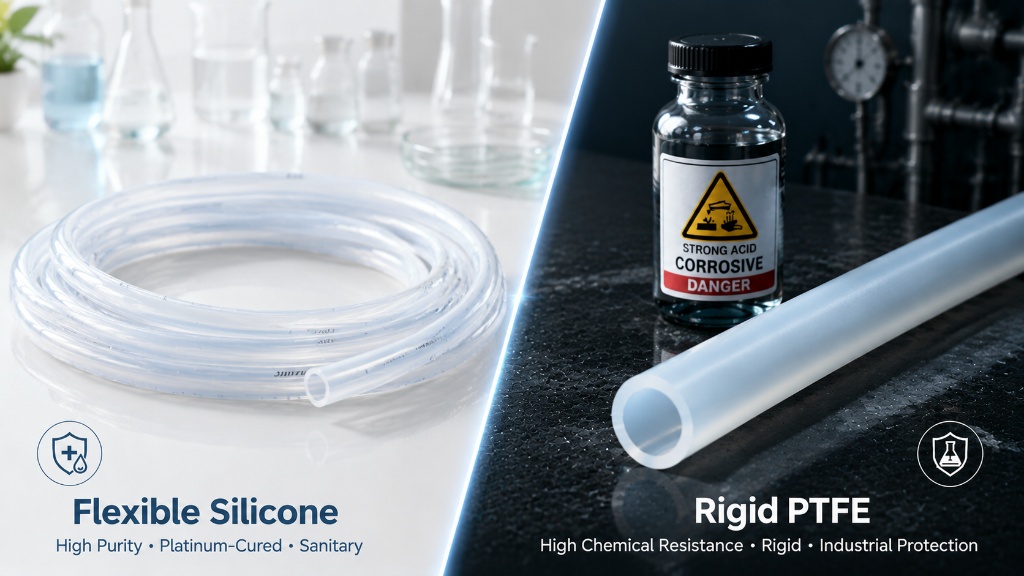
PTFE Tubing: Excellent Chemical Resistance
PTFE – you probably know it as Teflon – is a fluoropolymer with serious chemical toughness. It’s about as inert as you can get. Strong acids? No sweat. Aggressive bases? Bring them on. Organic solvents? PTFE barely even notices them. Its molecular structure is rock-solid, and the surface is so slick that fluids glide through with minimal sticking or buildup. It also handles high temperatures that would turn many other materials into puddles.
But there’s a catch. Standard rigid PTFE tubing has very little elasticity. Squeeze it flat under a pump roller, and it won’t snap back quickly – sometimes it won’t snap back at all. That’s a deal-breaker for standard peristaltic pumps, unless the tubing has been specially engineered with a composite structure or a flexible liner.
Silicone Tubing: Flexible Material for Repeated Pumping
Platinum-cured silicone tubing is the exact opposite. It’s a synthetic rubber built for motion. The elasticity is outstanding. A roller comes by, squashes it flat, and the tube rebounds almost instantly. That quick recovery keeps the suction steady and the flow consistent, cycle after cycle. Plus, silicone is transparent. You can see exactly what’s flowing through – bubbles, particles, colour changes – all visible at a glance.
For most water-based fluids, food products, and pharmaceutical applications, silicone tubing hits the sweet spot between performance and cost. That’s why pump manufacturers recommend it so often – it plays nicely with the mechanics of a peristaltic pump.
PTFE vs Silicone Tubing: 7 Key Performance Differences
When you’re evaluating tubing for a peristaltic pump system, these seven performance dimensions really matter.
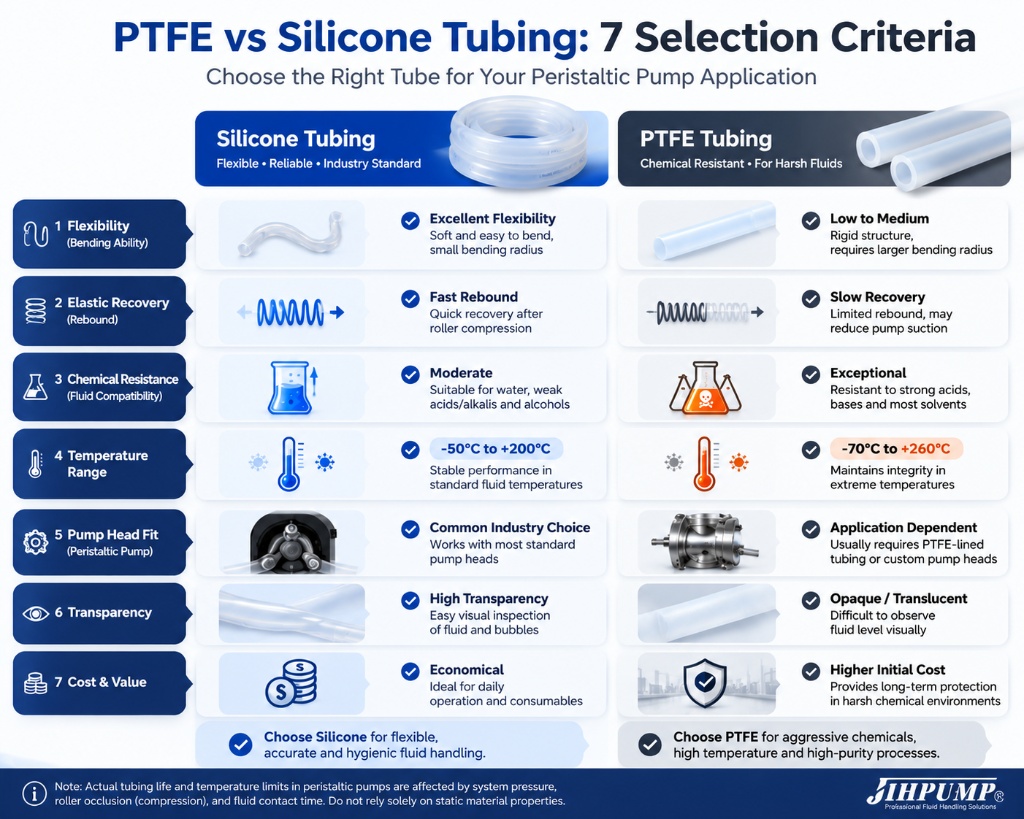
Flexibility:
Silicone is extremely flexible. You can bend it around tight corners and route it through the pump head without any hassle.
PTFE, on the other hand, is rigid. It needs larger bend radii and careful installation. Force it into a tight spot and it will kink or crack.
Elastic Recovery:
This is where silicone absolutely wins. After the roller passes, silicone springs back almost immediately. That fast rebound maintains suction and keeps flow stable.
PTFE recovers slowly, if at all. Under standard pump heads, that slow rebound leads to loss of prime, reduced flow, and erratic performance.
Chemical Resistance:
Silicone works great with water-based fluids and mild chemicals. But throw oils, hydrocarbons, or strong solvents at it, and you’ll see swelling or degradation over time.
PTFE is the champion here. It resists nearly everything – strong acids, bases, and aggressive solvents don’t faze it.
Temperature Resistance:
Silicone handles a decent temperature range, which works fine for standard fluid transfer and sanitary applications. The actual limits depend on the specific formulation and tubing construction.
PTFE generally offers a wider temperature window and better stability at high heat. But remember – in a peristaltic pump, mechanical compression matters just as much as the material’s static temperature rating.
Peristaltic Pump Fit:
Silicone is the industry standard. It fits right into most pump heads without special adjustments.
PTFE is more complicated. Standard rigid PTFE doesn’t fit or function well in standard pump heads. You usually need a composite tube or a specially designed pump head to make it work.
Transparency:
Silicone is highly transparent. You can see the fluid moving, check for bubbles, and spot any contamination instantly.
PTFE is opaque or at best translucent. Visual inspection is difficult, so you have to rely on sensors or other methods to monitor flow.
Cost & Value:
Silicone costs less upfront. It’s affordable and widely available, which makes it a great consumable for routine applications.
PTFE is more expensive initially, but in aggressive chemical environments, that higher cost pays off by preventing leaks, spills, and unplanned shutdowns.
One important note: tube life in a peristaltic pump isn’t just about the material. System pressure, roller occlusion, and the contact time between fluid and tube all play a role. Static material properties only tell part of the story.
Which Tubing Performs Better in a Peristaltic Pump System?
A lot of engineers make the same mistake. They assume that the “best” material on paper will automatically perform best in the pump. But a peristaltic pump is a dynamic system. Mechanical rebound is often more critical than chemical resistance or temperature tolerance.
Why Silicone Usually Performs Better in Peristaltic Pumps
Here’s the simple truth. In a standard peristaltic pump, properly selected silicone tubing with the right hardness delivers fast recovery after roller compression.
That fast recovery means stable flow and longer mechanical life. Think about the pump cycle. Roller squeezes the tube, pushes fluid forward, then releases. The tube snaps back, creates a vacuum, and pulls in the next slug of liquid. If the tube doesn’t snap back fast enough, the vacuum is weak, flow becomes pulsatile, and the motor has to work harder. Silicone’s elasticity keeps everything smooth. The motor runs under lower load, flow is consistent, and the tube lasts longer.
Why PTFE Can Be Difficult in Standard Peristaltic Pumps
Standard rigid PTFE tubing in a standard pump head is a recipe for trouble. The lack of elastic recovery means the tube stays compressed after the roller passes. Fluid doesn’t get pulled in properly, flow drops off, and the pump loses prime. On top of that, rigid tubing puts extra stress on the rollers and the motor. You might see overheating, excessive wear, or even a complete stall. For aggressive fluids, a PTFE-lined composite tube is often the better answer. But even then, the whole assembly has to be designed to match the pump head’s compression requirements.
When Should You Choose Silicone Tubing?
If your project involves high-frequency dosing, sanitary transfer, or automated fluid control, silicone is probably your best bet.
Food & Beverage Processing:
For milk, juice, syrup, and other non–oily food products, food-grade silicone tubing is a clean and efficient choice. Platinum-cured silicone that meets FDA food-contact standards gives you a transparent, flexible fluid path that’s easy to inspect. You can see bubbles or cleaning residue at a glance, which makes validation and quality control much simpler.
Laboratory & Analytical Dosing:
In in-vitro diagnostic instruments or water quality monitors, silicone tubing delivers the repeatable dosing accuracy you need. When you’re building a high-precision reagent dispensing system, quality silicone tubing for peristaltic pumps ensures that every drop volume stays consistent over long runs.
Pharmaceutical & Medical Diagnostics:
High-purity platinum-cured silicone offers excellent biocompatibility and can handle autoclave sterilization. Whether you’re transferring cell culture media or filling drug vials, accurate fluid delivery with silicone tubing minimizes the risk of particle shedding or chemical leaching.
When Should You Choose PTFE Tubing?
Yes, PTFE has mechanical limitations. But in certain extreme industrial environments, those limitations are worth it. The chemical resistance is unmatched.
Aggressive Industrial Chemicals:
When you need to pump concentrated sulfuric acid, nitric acid, strong bases, or solvents like acetone and toluene, PTFE is the clear winner. Silicone would swell and fail in these conditions. The chemicals literally penetrate the rubber, causing distortion and loss of sealing. PTFE stands up to them without degradation.
High-Temperature Chemical Dispensing:
PTFE offers excellent thermal and chemical stability for hot fluid handling. But here’s the caveat: high-temperature applications involving repeated peristaltic compression need careful evaluation. The pump head design, tube construction, and actual operating conditions all matter. Static temperature resistance alone doesn’t guarantee success in a pump.
High-Purity Solvents:
In analytical systems and high-purity fluid handling, PTFE’s inertness is a major advantage. It leaches almost nothing into the fluid, which keeps your solvents clean and your results accurate.
PTFE vs Silicone Tubing: Which One Is Safer?
Safety depends entirely on what you’re pumping. For food and medical applications, properly certified silicone is the safer choice. For aggressive chemicals, PTFE prevents leaks and failures.
For most biological, medical, and food applications, platinum-cured silicone that meets FDA food-contact standards or passes USP Class VI testing provides a high level of purity and safety. Properly manufactured silicone minimizes taste transfer and extractables. With food-grade peristaltic pump tubing, you meet strict food safety regulations without cutting corners.
For strong acids, bases, or hot solvents, PTFE’s safety comes from its ability to resist chemical attack. Silicone in a strong solvent will swell, weaken, and eventually rupture. That rupture can lead to leaks, spills, and contamination. In these cases, chemically compatible PTFE tubing reduces the risk of degradation and leaks. But remember, overall system safety also depends on tubing design, connections, pressure, temperature, and proper installation.
Common Mistakes When Selecting PTFE and Silicone Tubing for Peristaltic Pumps
Here are three mistakes we see all the time. Avoid them and you’ll save yourself a lot of headaches.
Mistake 1: Evaluating Chemical Resistance Only
It’s tempting to look at a compatibility chart and pick the most resistant material. But if you ignore mechanical flexibility, you can end up with a tube that the pump head can’t even compress. Standard rigid PTFE is a classic example. It resists almost everything chemically, but in a standard pump head, the rollers can’t squeeze it properly, and the pump loses prime immediately.
Mistake 2: Installing Standard Rigid PTFE in Standard Pump Heads
Forcing a standard rigid PTFE tube into a regular pump head puts enormous stress on the motor. Flow becomes wildly inaccurate, rollers wear out faster, and the motor can overheat and fail. If you need PTFE, look for composite tubing specifically designed for peristaltic pumps.
Mistake 3: Ignoring Tubing Hardness and Dimensional Tolerances
Peristaltic pumps are sensitive to wall thickness and Shore hardness. A tube that’s too hard increases mechanical wear. One that’s too soft can’t handle back pressure. And if the wall thickness is off by just a few tenths of a millimeter, the compression ratio changes, and your flow rate drifts significantly.
How to Choose Between PTFE and Silicone Tubing? (4-Step Guide)
Follow these four steps to make a systematic decision.
Step 1: Verify Fluid Compatibility
Start with the fluid. Is it water-based, non-oily food, or mild acid or base? Silicone is usually fine. Is it a strong acid, strong base, organic solvent, or concentrated oil? You probably need PTFE or a composite alternative.
Step 2: Assess Pump Operating Conditions
Look at roller speed, system back pressure, occlusion, and tubing hardness. Properly selected silicone handles repeated compression well and offers long service life under standard conditions.
Step 3: Define Temperature Requirements
Check your fluid temperature and any cleaning procedures like CIP or SIP. Silicone can handle typical steam sterilization. For continuous high-temperature industrial service, evaluate PTFE.
Step 4: Balance Cost and Service Life
Weigh the upfront tube cost against downtime and replacement frequency. Silicone is affordable and easy to replace. PTFE composites cost more but extend maintenance intervals in aggressive chemical environments.
Conclusion
Here’s the bottom line. Understanding the strengths and weaknesses of PTFE and silicone tubing in peristaltic pump systems helps you balance chemical safety, pumping accuracy, and long-term maintenance costs.
Need high elasticity, precise dosing, water-based reagents, or food and pharmaceutical fluids? Go with platinum-cured silicone tubing.
Need to handle concentrated acids, strong bases, organic solvents, or hazardous industrial chemicals? Choose PTFE composite tubing or a specially adapted pump configuration.
If you’re selecting tubing for an OEM project or a specialized fluid transfer application, reach out to the JIHPUMP technical team. They can provide professional fluid control support and sample testing to help you find the right fit.