
Demystifying the Peristaltic Pump Pulsation Dampener: Work Principle, Selection and Cost-Saving Secrets
Here’s something a lot of people don’t realize. A peristaltic pump pulsation dampener isn’t just some “vibration reducer” accessory. In many industrial transfer systems, the thing that really hurts your fill accuracy, pressure stability, and tubing life isn’t the pump itself. It’s the pressure pulsation that gets ignored for way too long.
So let’s walk through it. Why does a peristaltic pump create pulsation in the first place? How does a dampener actually work? When do you absolutely need one? And how can you combine pump head design and tubing optimization to get truly low pulsation transfer with less waste? That’s what we’ll cover.
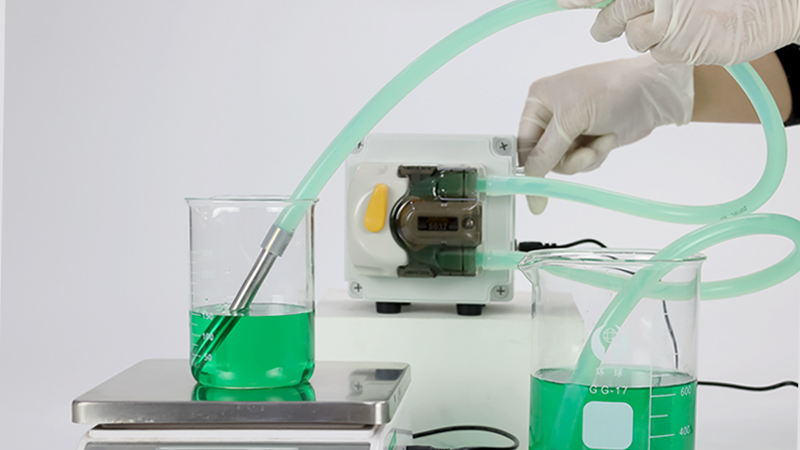
What is Pulsation and Why Do You Need a Dampener?
When someone first uses a peristaltic pump, the most obvious feeling isn’t “not enough flow.” It’s that the whole system feels… unstable.
The pressure gauge needle keeps swinging. The tubing vibrates constantly. Flow readings jump up and down. And after a few months, some fittings start leaking. The real problem behind all that? Usually not a broken pump. It’s pressure pulsation that’s been there all along.
To understand that, you first need to know the peristaltic pump working principle.
A peristaltic pump isn’t like a centrifugal pump that pushes continuously. Instead, rollers keep squeezing and releasing the tubing. The liquid moves forward in little “chunks”. Think of it like repeatedly pinching a straw with your fingers: when you squeeze, liquid moves forward; when you let go, the tube springs back and pulls in more liquid.
So the fluid actually goes through this cycle:
Push → Rebound → Push again → Rebound again
That repeating pattern is pulsation – a constant rise and fall in flow and pressure.
At low speeds, you might barely notice it. But when you increase the speed, tubing diameter, or peristaltic pump pressure, the whole system starts feeling those periodic shocks.
Here’s a key moment: right when a roller releases the tube, the tube snaps back to its original shape and creates a tiny local negative pressure (like suddenly letting go of a squeezed straw). That means a small amount of fluid actually flows backward for an instant. Then the next roller pushes it forward again.
Most issues people blame on “peristaltic pump pulsation” actually come from this constant push‑and‑suck action.
The tricky part is that most industrial systems hate high‑frequency pressure swings.
For example:
- Flow meters need steady flow to give accurate readings.
- Filling systems need continuous output to maintain precision.
- Pressure sensors need smooth pressure to avoid false alarms.
- Long pipelines gradually fatigue from constant vibration.
In fact, this chronic mechanical stress is a leading hidden cause behind why peristaltic pump tubing fails prematurely, causing unexpected cracks and leaks on the job site.
This table shows the impact more clearly:
| What you see in the system | What’s really happening |
| Pressure gauge constantly swinging | Internal pressure keeps going up and down |
| Fill volumes are inconsistent | Instant flow rate has peaks and valleys |
| Tubing vibrates a lot | High‑frequency pulsation travels to the line |
| Sensors give false triggers | Data readings get disturbed by pulsation |
| Fittings loosen and leak | Long‑term mechanical fatigue builds up |
That’s exactly why more and more systems use a peristaltic pump pulsation dampener.
Its main job isn’t to “increase pressure.” It’s to soften those repeated pressure spikes that beat up your system, so the fluid output becomes as smooth as possible.
After installing a dampener, the most obvious change on many job sites isn’t higher flow – it’s that the whole system finally calms down.
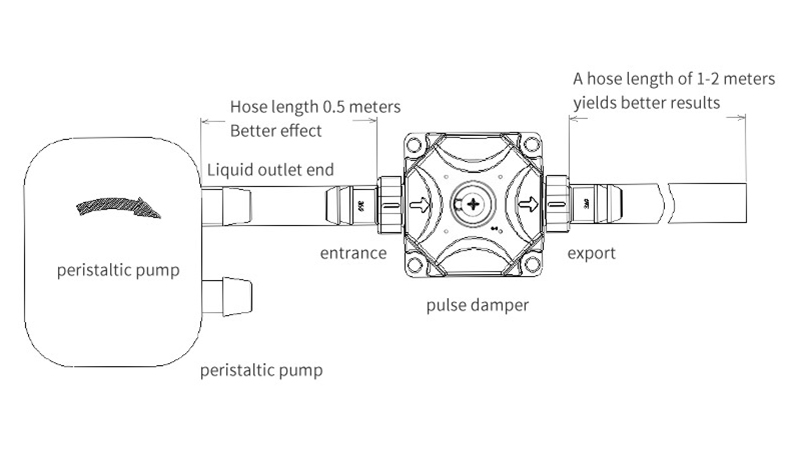
How Does a Peristaltic Pump Pulsation Dampener Work?
When people first see a pulse dampener for peristaltic pump, they often think there must be complex electronics or control mechanisms inside.
But honestly, most dampeners work on a pretty simple idea.
Think of it as a buffer chamber that “absorbs shocks” for your fluid system.
Inside, the dampener usually has two zones: liquid flows through the bottom, and the top holds trapped air (or an inert gas). Some better models add a diaphragm in between – a flexible membrane that gets pushed by pressure, keeping the air from touching the fluid directly.
The whole logic boils down to one sentence: store energy when pressure is high, release it slowly when pressure drops.
Here’s why that works. Liquid is almost impossible to compress. Air, on the other hand, compresses easily. So when a flow peak arrives, not all of that liquid immediately slams into the main pipe. Some of it goes into the dampener and compresses the air pocket. That excess pressure energy gets “stored” temporarily. Then, when the system hits a low point in the pulsation cycle, the compressed air pushes back and gently returns that liquid to the main line. The sharp pressure pulsation gets gradually smoothed out.
It’s a lot like a car shock absorber. Without shocks, hitting a bump makes the car bounce violently. With shocks, they absorb the impact first, then release the energy gradually – making the ride much smoother. Same idea here.
Here’s a quick comparison:
| Without dampener | With dampener installed |
| Flow is clearly pulsed | Flow is much closer to continuous |
| Pressure gauge swings fast | Pressure curve is noticeably smoother |
| Tubing vibrates easily | Vibration is greatly reduced |
| Sensors are easy to false‑trigger | Data readings become far more stable |
What really hurts system life over time isn’t the average pressure. It’s those repeated instantaneous spikes. That’s why low pulsation transfer keeps becoming more critical in high‑precision systems.
When is an Inline Pulsation Dampener Absolutely Required?
Not every peristaltic pump system needs a dampener.
If you’re moving ordinary liquid at low speed, many setups run just fine even with some pulsation. But in high‑stability applications, pulsation stops being just “a vibration problem” – it starts messing with your actual process results.
The most common case is high‑precision filling and dosing.
Whether you’re developing biotech reagents or calibrating a critical beverage filling machine, any minute pressure pulsation can cause shot volume to vary. Many of these machines fill only a few milliliters (or even less) per cycle. At that scale, even a tiny amount of pressure pulsation can cause each shot’s volume to vary.
People often blame the metering system and try to resolve it through repetitive calibration. However, even if you follow a strict peristaltic pump calibration handbook to adjust dosing deviations, you cannot completely fix the volumetric errors caused by the discontinuous flow itself. The pump simply doesn’t put out a perfectly steady stream without hardware dampening, and the closer the filling tip is to the pump, the more every single pulse shows up in your fill volume.
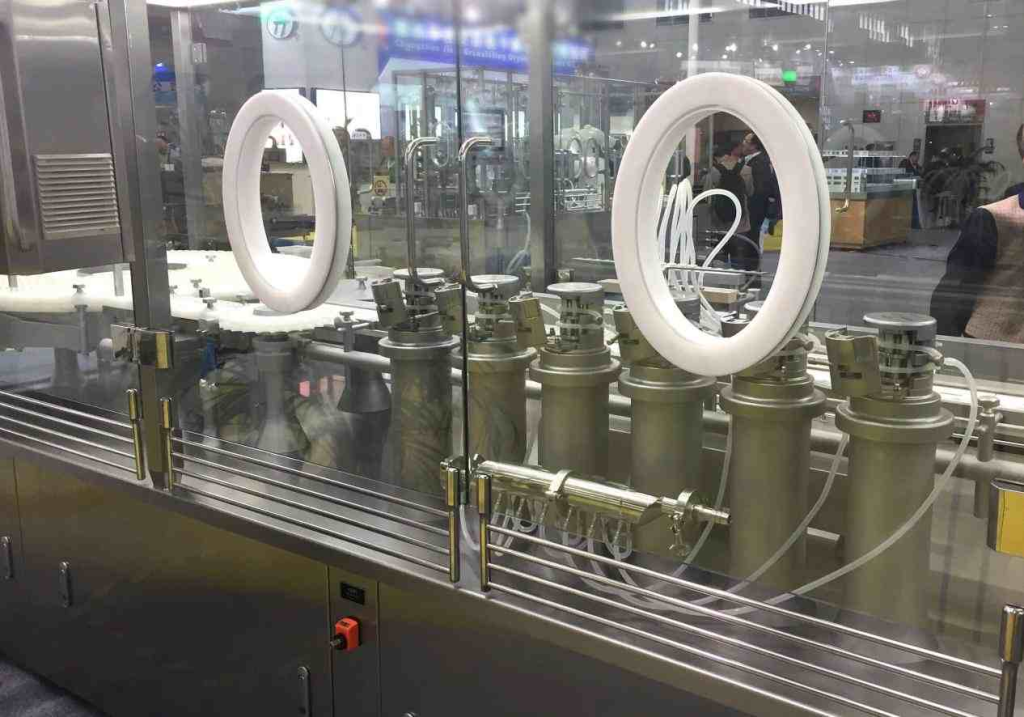
Another very typical situation is automated systems with lots of sensors. Flow meters, pressure transmitters, PID controllers – they all read “instantaneous” data. If the line is constantly swinging in pressure, the control system gets confused. It thinks the process is changing wildly when it isn’t.
That leads to valves opening and closing too often, false alarms, wrong decisions from the PLC, and frequent shutdowns.
On many job sites, what people call “control system instability” is actually just peristaltic pump pulsation that never got dampened properly.
And in high‑pressure conditions, the problem gets even worse. Pulsation doesn’t just affect flow – it becomes a constant mechanical hammering. After months of running, the first things to fail aren’t the pump. It’s the fittings, clamps, seals, and elbows.
On long transfer lines, pulsation can even create resonance – where vibration frequencies build up and amplify each other (like a bridge starting to sway when soldiers march in step). That’s why some systems leak at the exact same spot over and over, even though the pressure gauge never shows an overload.
Use this table to quickly check if you really need a dampener:
| Application | Dampener recommended? | Why |
| High‑precision filling | Strongly recommended | Reduces instant flow fluctuations |
| Sensor‑dense automation | Strongly recommended | Improves data stability |
| Long‑distance transfer | Recommended | Lowers tubing vibration |
| High‑pressure conditions | Recommended | Reduces mechanical shock |
| Ordinary low‑speed transfer | Optional | Pulsation impact is smaller |
Choosing the Right Type of Peristaltic Pump Pulsation Dampener
A lot of buyers fall into the same trap the first time they pick a dampener: “The more smoothing, the better.”
But in real industrial systems, the more useful question is usually: how low does your pulsation actually need to be?
Most common dampeners fall into two core types:
| Type | Key features | Best for |
| Passive Air Chamber | Simple, low cost, little maintenance | Wastewater, ordinary chemicals, glues |
| Active Diaphragm | More stable smoothing, isolates air from liquid | Biopharma, expensive drug solutions, corrosive fluids |
The passive air chamber type works by letting the internal air pocket absorb pressure pulsation. Its biggest advantage isn’t extreme performance – it’s low cost, reliability, and easy upkeep. For many low‑ to medium‑pressure systems, if you pick the right size, it already cuts tubing vibration noticeably.
But it has a real limitation: air slowly dissolves into the liquid. After running for a long time, the air cushion shrinks, and the dampening effect decreases. That’s why some systems feel great right after installation, but a few months later the pulsation starts creeping back.
The active diaphragm type is a better fit when you need truly low pulsation with high consistency. The diaphragm keeps air and liquid separate. That gives you more stable cushioning and also prevents air from touching your process fluid. In biopharma or high‑value chemical transfer, that’s a big deal.
A mature selection approach doesn’t just stare at “smoothing percentage.” It balances system pressure, fluid value, cleaning frequency, maintenance access, and process stability needs. Often, the system doesn’t need “zero pulsation.” It needs long‑term stable and controllable operation.
Other Efficient Ways to Reduce Flow Pulsation
Many people think the only way to fix pulsation is to add a dampener.
But a truly mature low pulsation system usually comes from combining pump head design + dampener + tubing layout. Sometimes optimizing the system structure gives you a bigger improvement than just upsizing the dampener.
Upgrading the Peristaltic Pump Head Design
The ideal approach is to reduce pulsation at the source.
Traditional pump heads use a “squeeze hard, release fast” motion, so the liquid clearly moves in “bursts”. Some improved pump heads, however, optimize the roller track to make tube compression much gentler.
In simple terms: don’t suddenly shove the liquid.
This gradual‑curve track design can noticeably lower instant pressure pulsation. Some advanced pump heads even use a two‑tube, phase‑difference design. Think of it like noise‑canceling headphones: when one tube is at a flow peak, the other is near a trough. When the flows merge, they partially cancel each other out.
Balancing Dead Volume and Tubing Compliance
Here’s something that drives operating costs up over time – not electricity, but wasted liquid. In high‑value fluid systems, what really bothers engineers is dead volume (the space inside components that never fully drains, like the last drop at the bottom of a bottle).
A larger dampener usually means more leftover liquid inside.
If you’re pumping cheap cleaning solution, that might not matter. But for expensive drugs, UV inks, or materials that cure and stick, every bit of fluid trapped in the dampener during a batch change is real cost. That’s why experienced engineers don’t blindly chase “bigger dampener.”
A common rule of thumb in the industry: choose a dampener with effective volume about 5 to 10 times the pump’s displacement per cycle.
That gives you effective pressure pulsation reduction without turning your system into a “liquid storage tank.”
Another thing that’s easy to overlook: tubing compliance. That’s just a fancy way of saying the tubing can expand a tiny bit and soak up some pressure waves – kind of like a balloon softening a shock.
Here’s a trick you’ll see on a lot of job sites. Engineers often leave a short piece of soft, flexible tubing right after the dampener. Why? Hard piping just passes whatever pulsation is left straight through. But flexible tubing? It keeps absorbing some of those low‑frequency tail vibrations. Simple move, but it works surprisingly well.This trick sounds simple, but on tight budgets, it often works better than adding more expensive hardware.
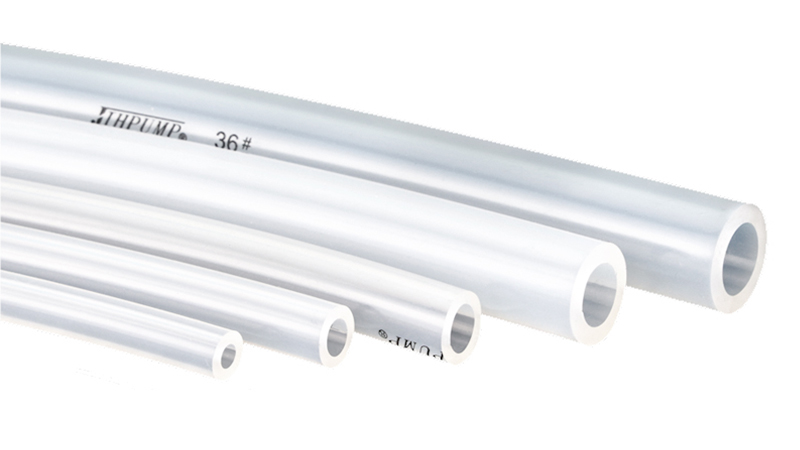
A truly mature low pulsation system doesn’t rely on one “big hero component.” It comes from many small details working together.
Final Thoughts
Solving peristaltic pump pulsation has never been just “add one more part.”
A genuinely stable low pulsation transfer system usually needs you to look at the pump head design, dampener sizing, tubing layout, and hose material – all working together.
Most systems don’t need “zero pulsation.” What they really need is long‑term stable, controllable, and reliable fluid transfer at a reasonable cost. For engineers who handle high‑precision fluids, expensive drug solutions, or automated processes day after day, understanding where pressure pulsation comes from is often more valuable than just swapping out equipment.